What is the best customer communication management software?
Based on our 2026 testing for speed, AI accuracy, and omnichannel integration, the top 3 tools are:
Airchannel AI: Best overall for speed and AI-native automation.
Zendesk: Best for large enterprise support teams.
Front: Best for teams that focus primarily on shared email inboxes.
Your team is missing messages right now.
Not because your people are bad at their jobs. Because your tools are broken. You have one tab for email, another for WhatsApp, and a third for SMS. Leads come in. No one sees them in time. The reply goes out 6 hours late. The customer already signed with a competitor.
That is not a people problem. That is a software problem.
Customer communication management (CCM) software is supposed to fix this. But most tools on the market were built before AI existed, then had AI features bolted on as an afterthought. The result is slow, clunky software that still requires your team to do most of the heavy lifting.
This guide cuts through the noise. We ranked 10 CCM platforms based on what actually matters: how fast they work, how easy they are to set up, and whether the AI actually helps or just gets in the way.
How We Tested These Tools
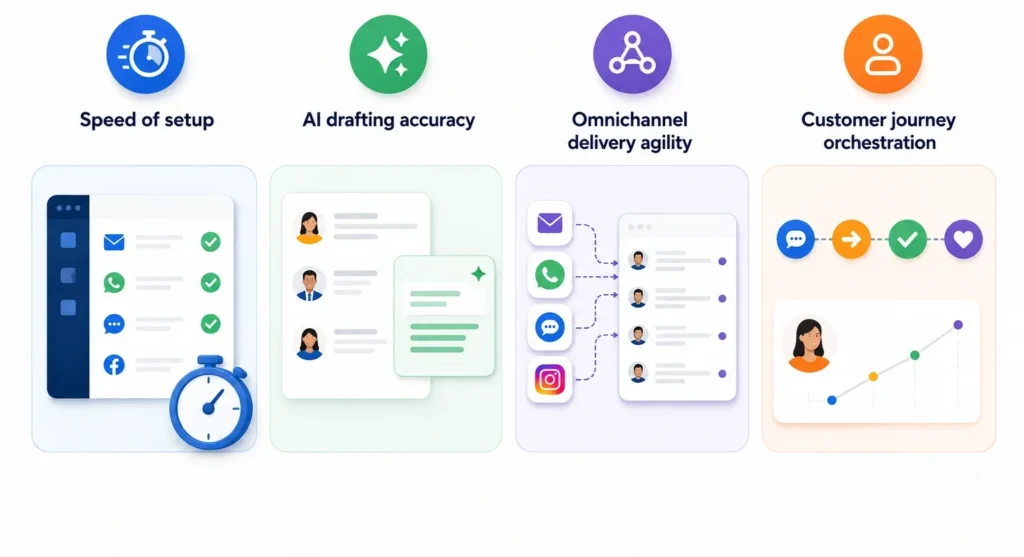
We evaluated each platform across four areas:
Speed of setup. Could a non-technical team member connect their channels and send a reply within the first hour? Legacy tools failed this test immediately.
AI drafting accuracy. Does the AI read conversation history and match tone? Or does it spit out generic, robotic replies that your team rewrites anyway?
Omnichannel delivery agility. Can the platform handle email, WhatsApp, SMS, and social from a single view? Switching tabs kills response time.
Customer journey orchestration. Does the tool help teams track where a customer is in the conversation lifecycle, not just log individual messages?
We did not give bonus points for feature count. Bloated software with a 200-page setup guide is not a solution. It is a liability.
The Top 10 Customer Communication Management Software Tools
1. Airchannel AI

Every other tool on this list added AI features to an existing product. Airchannel AI was built with AI at the center from day one. That distinction matters more than any feature list.
Instead of a bot that talks to customers poorly, Airchannel uses Smart Drafts. The AI looks at your past conversations and brand history to write a suggested reply. Your team stays in control, but they never have to start from a blank page again.
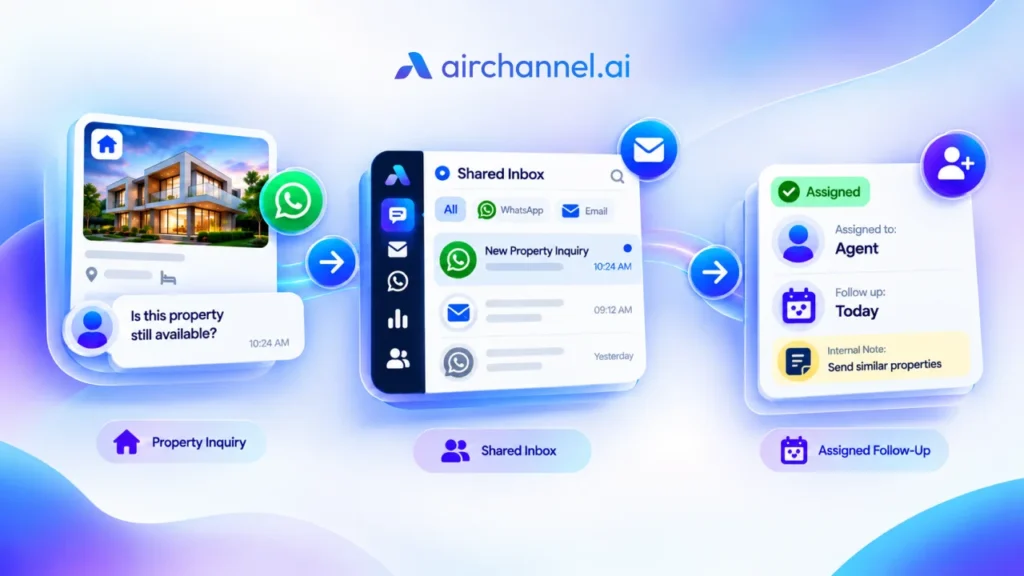
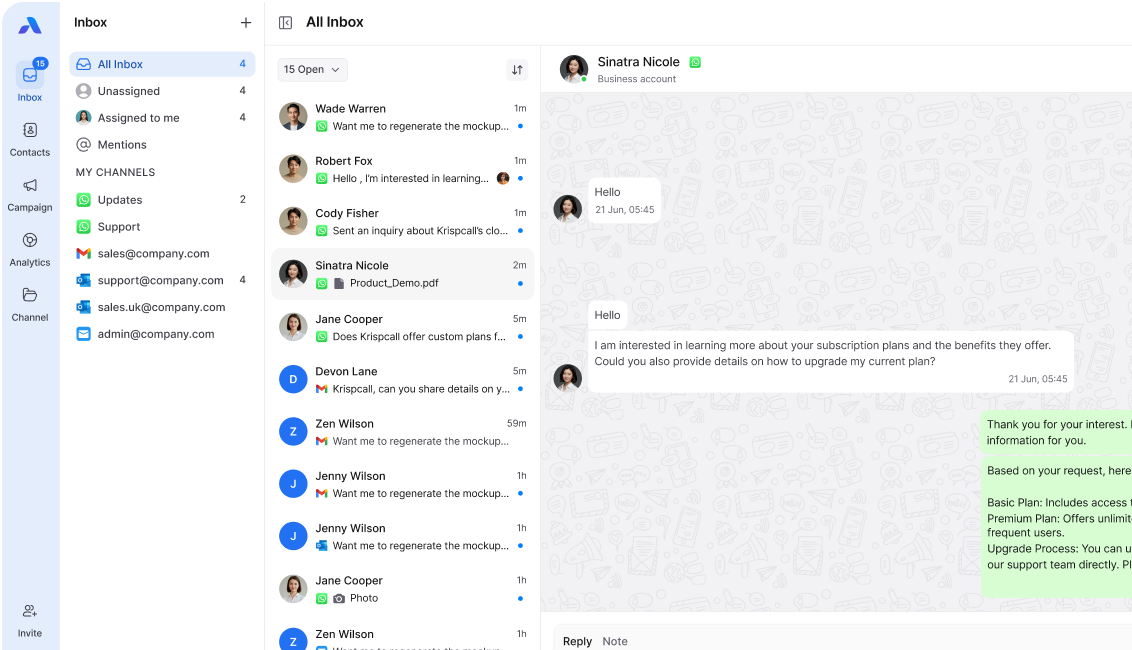
Airchannel is a cloud-native shared inbox that unifies your three biggest channels: Email, WhatsApp, and Outlook. Setup takes about 5 minutes. No consultants. No migration headaches. No months of onboarding.
Who it is for: Startups, SMBs, and fast-moving teams that need omnichannel delivery agility without the enterprise price tag.
Key features:
- Unified inbox across all channels
- AI-drafted replies based on conversation history and tone
- Internal notes, assignments, and team collaboration are built in
- Template and brand voice management from a central dashboard
- End-to-end encryption and role-based access
- Scales from 5-person teams to growing businesses
The verdict: The only truly AI-native platform on this list. If your team handles more messages than it can answer in time, this is where you start. The most secure, easy-to-use inbox for Email, WhatsApp, and SMS.
The Catch: It does not currently support Instagram or Facebook Messenger. It is focused on the core business channels: WhatsApp, and Email.
2. Zendesk

Verdict: A mature, well-built helpdesk platform. Solid for large support teams that live inside a ticketing workflow. But the AI features that matter most are locked behind higher-tier plans, and pricing scales fast as your team grows.
Starting price: ~$19/agent/month (basic). AI features start at $50+/agent/month.
The catch: Zendesk was built for ticketing, not customer journey orchestration. It tracks issues, not relationships. Teams wanting proactive, AI-powered communication will find themselves paying enterprise rates for features that Airchannel AI includes by default.
3. Quadient
Verdict: Purpose-built for high-volume, document-heavy industries like banking, insurance, and utilities. If you need to send thousands of bills, statements, or compliance letters across print, email, and web portals, Quadient handles it well.
Starting price: Custom enterprise pricing. Expect a significant investment.
The catch: Implementation takes months. Migration from legacy systems is a project in itself, often requiring a dedicated IT team. If your team uses Slack or modern apps, you will hate this
4. Adobe Experience Manager (AEM)

Verdict: If you are a Fortune 500 brand already deep in the Adobe ecosystem, AEM gives you powerful content management and personalization at scale. It integrates with Analytics, Target, and Campaign in ways no other platform matches.
Starting price: Custom. Budget for six figures annually, plus Adobe-certified developer costs.
The catch: You need dedicated developers just to keep it running. AEM is not software your team picks up and uses. It is infrastructure. For teams that want omnichannel delivery agility without a development budget, this is the wrong choice.
5. Front
Verdict: Front solves one specific problem well: shared inboxes that still feel personal. Replies go out from real names, not a generic support alias. Internal comments and assignments are clean and easy. It is a good fit for relationship-driven teams managing email at volume.
Starting price: ~$19/seat/month.
The catch: Limited native AI. WhatsApp and SMS require third-party integrations, which adds cost and complexity. If your customer journey orchestration needs go beyond email, Front starts showing its limits quickly.
6. OpenText
Verdict: OpenText belongs in the same category as Quadient: heavy-duty, regulated-industry software for enterprises with compliance requirements. Document archiving, audit trails, and governance are strong.
Starting price: Custom enterprise pricing.
The catch: This tool requires significant IT resources to configure and maintain. It is not built for agility. It is built for compliance. Cloud-native architecture is not a phrase that describes OpenText’s core product philosophy.
7. Intercom
Verdict: Intercom is excellent for product-led SaaS companies that want to engage users inside the app. The Fin AI chatbot is one of the better automation tools on the market for handling common questions at scale.
Starting price: ~$39/seat/month. Costs rise sharply with contact list size.
The catch: Pricing is unpredictable. As your list grows, your bill grows fast. Teams that do not carefully monitor usage often face surprise invoices. Also, Intercom is built for marketing and product engagement, not support-heavy workflows.
8. Salesforce Service Cloud

Verdict: If your company is already running Salesforce CRM, Service Cloud is the logical extension. It pulls customer data, case history, and AI recommendations (via Einstein) into one view. Omnichannel routing across communications channels is genuinely strong.
Starting price: ~$25/user/month (base). Full AI and automation features require higher tiers.
The catch: You almost certainly need a Salesforce consultant to implement this correctly. It is not a plug-and-play platform. Budget for implementation costs on top of licensing fees. Best suited for teams already inside the Salesforce ecosystem.
9. Podium

Verdict: Built specifically for local, service-based businesses. If you run a dental clinic, auto dealership, or home services company and you want to collect reviews and send appointment reminders via SMS, Podium does that simply and well.
Starting price: ~$399/month (flat fee).
The catch: It is narrow by design. Complex content management, multi-channel workflows, or B2B use cases are not where Podium performs. If your communication needs go beyond SMS and reviews, you will hit its ceiling quickly.
10. Braze
Verdict: Best-in-class for consumer apps and e-commerce brands running sophisticated marketing automation. The customer journey builder, push notifications, and A/B testing tools are genuinely impressive at scale.
Starting price: Custom enterprise pricing.
The catch: Braze is a marketing platform, not a support tool. There is no ticketing system. There are no agent-focused collaboration tools. If your team needs to respond to individual customer messages and track those conversations, Braze is not built for that.
Quick Comparison: Top 3 Tools
| Feature | Airchannel AI | Zendesk | Quadient |
| AI capabilities | Native (core product) | Add-on (paid tier) | Rules-based only |
| Setup time | ~5 minutes | Weeks | Months |
| Omnichannel support | Email, WhatsApp, Outlook, IMAP | Email, Chat, Social | Email, Print, SMS, Web |
| Data security | Enterprise-grade | Enterprise tier add-on | Enterprise-grade |
| Pricing | Startup-friendly | Mid-market | Enterprise only |
How to Pick the Right CCM Software
Does the AI actually draft, or just suggest?
The difference between AI that writes a reply and AI that shows you a dropdown of templates is enormous. Look for cloud-native architecture with sentiment analysis built in, not layered on top. The AI should read the conversation and produce a draft that your team can send with minimal edits.
Can it handle all your channels without switching tabs?
Omnichannel delivery agility is not a buzzword. It is the difference between a team that replies in 4 minutes and one that replies in 4 hours. If your customers use WhatsApp and your software does not, you are already losing.
Does it support real customer journey orchestration?
CCM software should help your team understand where every customer is in the conversation, not just log what was said. Look for assignment tracking, conversation history, and status views that give your team full context before they reply.
Will migration from legacy systems take weeks or months?
This is the question most buyers forget to ask. A tool is only as good as your ability to actually use it. If onboarding requires a consultant and a six-month implementation, the disruption may outweigh the benefit.
The CCM Friction Calculator

Before you pick a tool, know what your current setup is costing you.
Use this rough estimate to calculate monthly revenue lost from slow or missed replies:
Step 1. How many inbound leads or customer messages does your team receive per day?
(Example: 50 messages/day)
Step 2. What percentage goes unanswered within 1 hour?
(Industry average for teams without CCM software: 40%)
(Example: 20 messages/day missed or delayed)
Step 3. What is your average deal or retention value per customer?
(Example: $200/customer)
Step 4. Estimate a 15% conversion rate on timely replies.
(Example: 20 missed x 0.15 = 3 potential customers lost/day)
Step 5. Multiply by 30 days.
(Example: 3 x $200 = $600/day x 30 = $18,000/month in friction losses)
Most teams run this math and realize the cost of doing nothing is far higher than the cost of switching tools. A platform with cloud-native architecture and AI reply drafting can close this gap in days, not quarters.
Conclusion: Don’t Buy 2010 Technology for a 2026 Problem
Most CCM platforms are playing catch-up. They are trying to “add” AI to old code. AI-native tools like Airchannel AI are winning because they focus on one thing: Speed to Lead.
Stop losing leads to messy inboxes and “Ferrari” software you can’t drive.
👉 Request a Demo with Airchannel AI and see what an AI-native inbox looks like in action.
FAQs (Frequently Asked Questions)
What is the best CCM software for a small business?
Airchannel AI is best because it offers enterprise-grade AI without the enterprise price or setup time.
Is Salesforce Service Cloud worth it?
Only if you already use Salesforce CRM and have a dedicated admin to manage it.
Does CCM software support WhatsApp?
Modern tools like Airchannel AI and Intercom have native WhatsApp support. Legacy tools usually require expensive add-ons