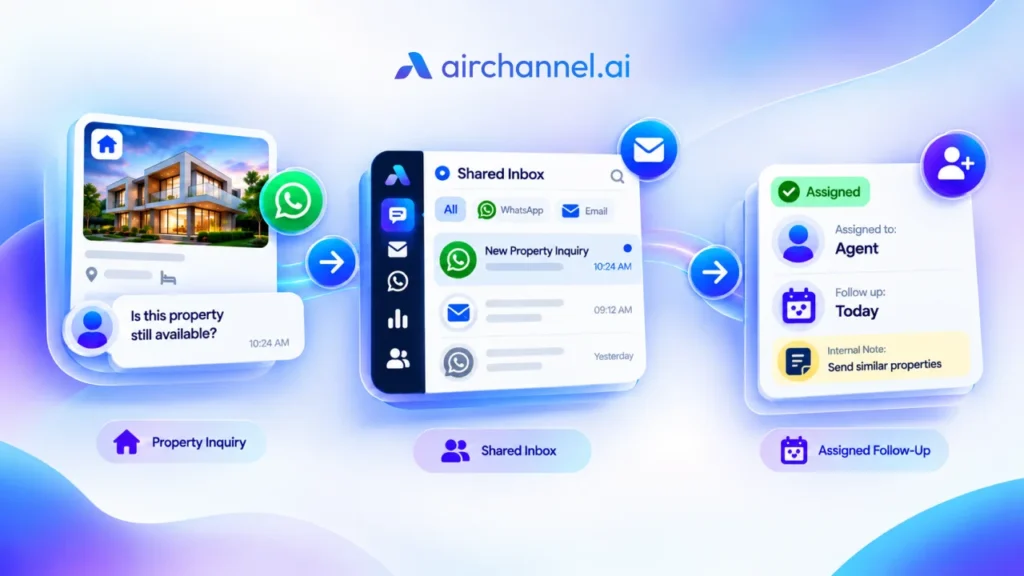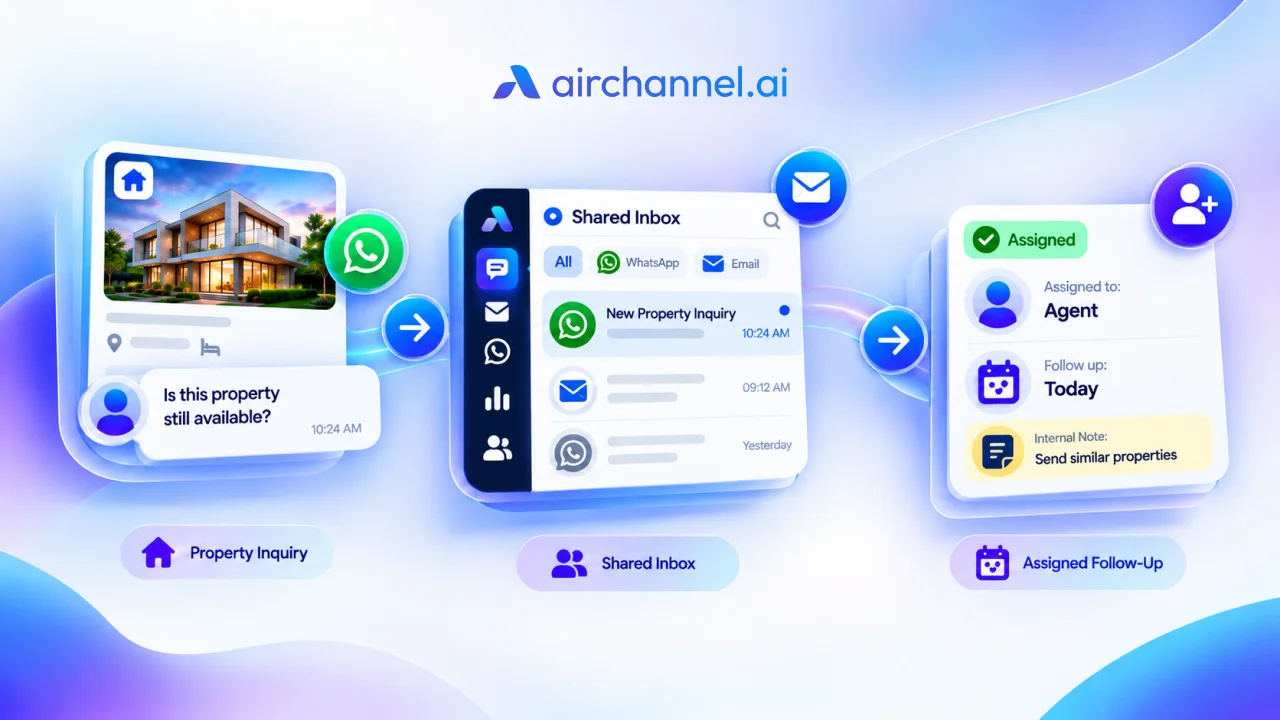
A buyer asks about a two-bedroom apartment on Monday. An agent sends the details, and the buyer says thanks. A week later, nothing has happened because nobody recorded what should come next.
Most real estate lead follow-up problems are not caused by bad scripts. They are caused by missing ownership, scattered conversations, and no recorded next action.
This guide starts with how one agent follows up, then shows how a team makes follow-up work, and where a shared communication tool fits.
Quick Answer: How Do I Follow Up With Leads?
Follow up with context, a useful reason, and one clear next step. In short:
- Respond as soon as your team reasonably can.
- Refer to the property or question that started the conversation.
- Ask one useful question.
- Share something relevant, like a similar listing or an answer they need.
- Suggest one clear next step, such as a viewing time.
- Use the channel the lead prefers.
- Record what happened and when the next follow-up is due.
- If they are not ready, move them into longer-term nurturing.
Real Estate Lead Follow-Up at a Glance
Real estate lead follow-up is everything you do after a lead first shows interest: responding, learning what they need, and staying in touch until they book a showing, become a client, or ask you to stop. Good follow-up combines a timely reply, context from the original inquiry, something useful to share, and a clear next step.
Teams add one named owner per lead, shared conversation history, and a recorded next action, so no lead depends on one person’s memory. Cadence should change with lead temperature, source, timeline, and communication preference. Leads who go quiet move into low-frequency nurturing.
What Is Real Estate Lead Follow-Up?
It covers the whole process after someone shows interest in a property, a neighborhood, or selling their home: your first reply, the questions you ask, who handles the lead, what you send, and how you record it. Repeated messages are only one part.
Effective follow-up has five parts: the right person, the right context, good timing, a useful reason to talk, and a clear next step. Tracking holds the parts together.
Real Estate Lead Follow-Up Process
| Stage | What happens | What good looks like |
| Lead arrives | An inquiry comes in by portal, website, WhatsApp, email, or phone | Captured in one place, with the source noted |
| Respond and qualify | You send the first reply and ask what they need | Timely, refers to the exact inquiry, one or two questions |
| Assign ownership | One agent takes the lead | A named owner the team can see |
| Follow up and add value | You send answers, listings, or market details | Every message has a purpose |
| Choose channel and next step | You pick phone, text, WhatsApp, or email, and propose one action | Matches their preference and permission |
| Track | You log status, promises, and the next date | Anyone can pick up the conversation |
| Nurture and re-engage | You stay useful at a lower pace until they convert or move on | Relevant updates, a check on whether plans changed, and the outcome recorded |
Why Do Real Estate Leads Go Cold?
Leads rarely go cold from one big mistake. Small gaps pile up, and they fall into two groups.
What the agent sends
- Slow replies. A buyer messages three agents on Saturday morning, and the first useful answer gets a head start.
- Generic, salesy messages. “Just following up” fits any lead, and five “ready to buy?” texts feel like pressure.
- No personalization or next step. The message ignores the property they asked about and leaves the buyer to guess what happens next.
- Poor timing. Calling a lead who asked for email.
- Stopping too early. One message, no reply, and the lead is written off.
- One cadence for everyone. A buyer who wants a viewing this week gets the same pace as a seller planning for next year.
How the team is set up
- Scattered communication. The lead wrote on WhatsApp, then emailed the office, and nobody connects the two.
- No clear owner. Two agents each assume the other replied.
- Poor handoffs. A new agent takes over with no notes.
- No follow-up system. Follow-up depends on who remembers.
Only a few of these problems are about wording. Most are about how the team is set up.
How to Follow Up With Leads in Real Estate: The REAL Follow-Up Framework
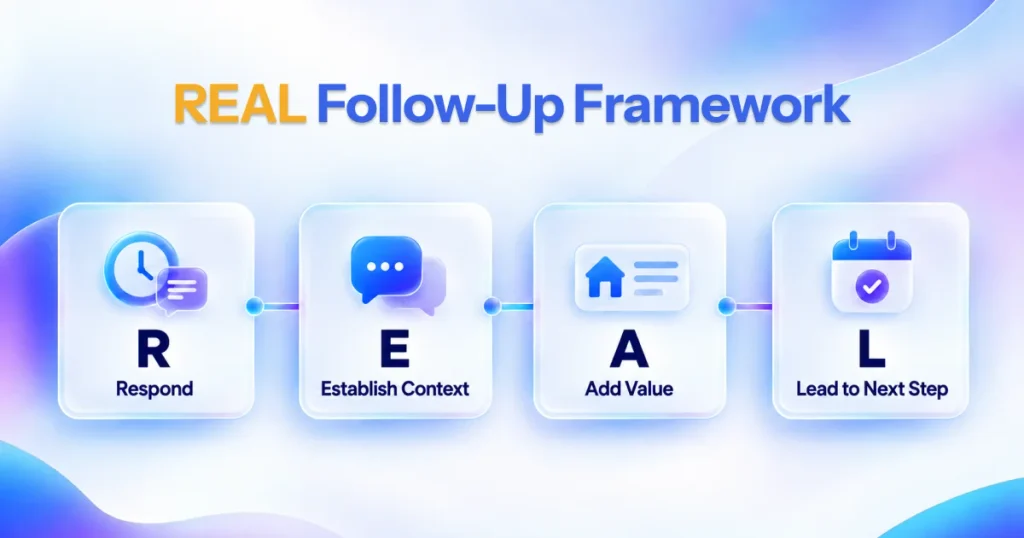
The REAL Follow-Up Framework gives you four checks to run before you send any follow-up: Respond quickly, Establish context, Add value, and Lead toward one next step. These steps can work for both solo agents and teams. The main difference is how ownership and tracking are handled.
R: Respond quickly
Respond as soon as your team reasonably can. The longer a lead waits, the more likely their attention moves elsewhere.
Harvard Business Review’s 2011 study of 1.25 million online leads from 42 US companies supports that direction. It found that firms contacting a lead within an hour were nearly seven times as likely to qualify it as firms that waited even an hour longer, where “qualify” meant a real conversation with the person who makes the decision.
That study was not specific to real estate, and it shows a link, not proof that speed alone causes sales. Treat it as a reason to set a response goal, not as a real estate benchmark. The National Association of Realtors also reports in its Profile of Home Buyers and Sellers that most buyers interviewed only one agent, so a slow first reply may cost you the chance to be considered.
E: Establish context
A lead contacted you for a reason. Your reply should show you read it.
Generic: “Hi Sara, just following up.”
Useful: “Hi Sara, you asked Monday about the two-bedroom on Palm Street. The owner confirmed it is still available, and Thursday afternoon is open for a viewing.”
The second message names the property, answers the question, and offers a next step. Then ask one question, such as “Which area interests you most?”, “Are you planning to buy soon, or still researching?”, or “What matters most to you in the property?”
One question gets an answer that shapes your next message. A list of six feels like a form.
A: Add value
Every follow-up should carry something the lead can use: a new listing, a price update, a similar property, market information for their area, an availability update, the answer to an earlier question, or a resource like a buyer checklist. “Just checking in” gives the lead nothing to respond to.
Add something new, or wait until you have something new.
L: Lead toward one next step
Close each message with one clear action. “Let me know” gives the lead no specific action to take, so it is usually weaker than a clear next step.
- “Would Tuesday or Wednesday work better for a viewing?”
- “Would you like me to send two similar properties?”
- “Would a quick call help you compare the options?”
Match the step to the lead. Offering to send listings is a lighter ask than booking a viewing, so it suits someone who is still researching.
Then log it: what the lead asked, what you promised, who owns the conversation, the lead’s stage, and the next follow-up date. Without that, your next message depends on memory.
Example 14-Day Real Estate Lead Follow-Up Schedule
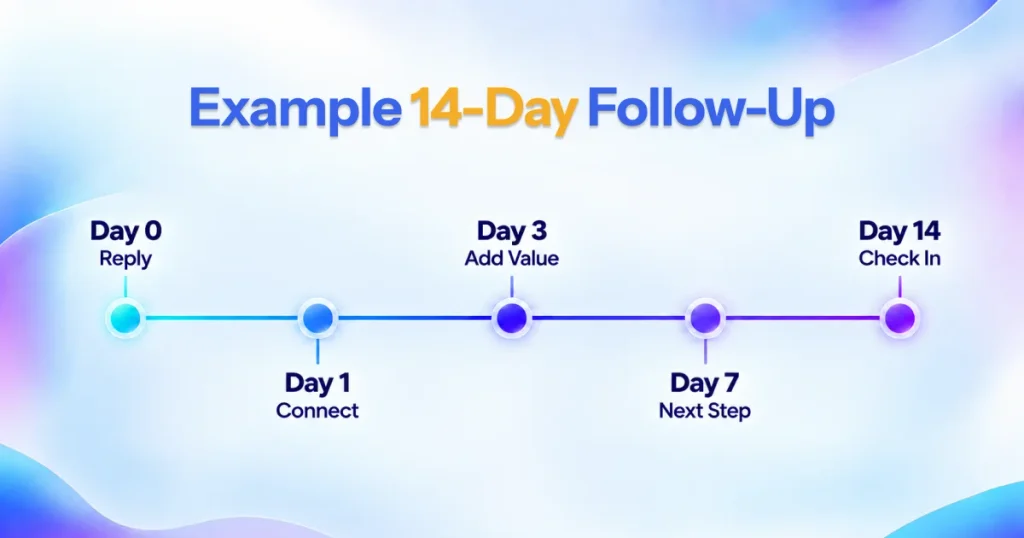
This is an example workflow, not an industry-standard cadence. The calendar tells you when to review the lead; the lead’s response tells you what to do next. Adjust it for lead intent, communication preference, timeline, lead source, and past responses.
14-Day Follow-Up Schedule
| Day | Channel | Purpose | What to do | Message direction |
| 0 | The channel the lead used | Respond and set context | Answer the inquiry and ask one question | Confirm the property details, then ask about timeline |
| 1 | Call if they gave a number and permission, otherwise the same channel | Connect and qualify | Recap what they need and offer a viewing | “Here is what I heard you want. Does that match?” |
| 3 | Text, WhatsApp, or email | Add value | Send two similar properties or a promised answer | Two options that match the budget they mentioned |
| 5 | Email or their preferred channel | Answer likely questions | Share neighborhood details, costs, or buying steps | Useful information, no sales push |
| 7 | Phone or message | Offer a next step | Propose two viewing times or a call | “Would Thursday or Friday work?” |
| 10 | Same channel as Day 3 | Share an update | New listing, price change, or status update | One update tied to their search |
| 14 | Their preferred channel | Ask whether plans changed | Ask about timing and offer to pause or continue | “Should I keep sending listings, or pause for now?” |
Let the lead’s response change the plan:
- They reply with a question: Answer it, then restart the schedule from that reply.
- They ask for a viewing: Treat them as hot and confirm a time.
- They say “not ready yet”: Move them to nurture and ask when to follow up.
- They ask you to stop: Stop and record it.
After Day 14, move the lead to long-term nurture instead of repeating the same rhythm, such as a relevant monthly note about their area or new listings that fit. If they reply, return to active follow-up. If they ask you to stop, stop and record it.
How Often Should You Follow Up? Hot, Warm, and Cold Leads
Lead temperature should change the next action, not just the label. Sort each lead, then change the pace, the content, and the next step.
Hot leads
They want a showing, asked about availability, have a near-term timeline, or reply actively.
Warm leads
They are interested but undecided, researching, replying now and then, or working on a longer timeline.
Cold leads
They have not replied recently, sent an old inquiry, or gave unclear timing.
Hot vs Warm vs Cold Lead Follow-Up
| Lead type | Starting pace | Content | Next action |
| Hot | Same day, then every day or two while active | Availability, viewing times, quick answers | Confirm a time |
| Warm | Every few days, then every couple of weeks | Comparisons, area guides, matching listings | Offer a shortlist or a call |
| Cold | Monthly or less | Market updates, one relevant listing | Ask whether plans changed, and whether to continue |
These paces are starting points, not benchmarks. Do not keep contacting people who clearly do not want communication.
Why Real Estate Lead Follow-Up Breaks Down as Teams Grow
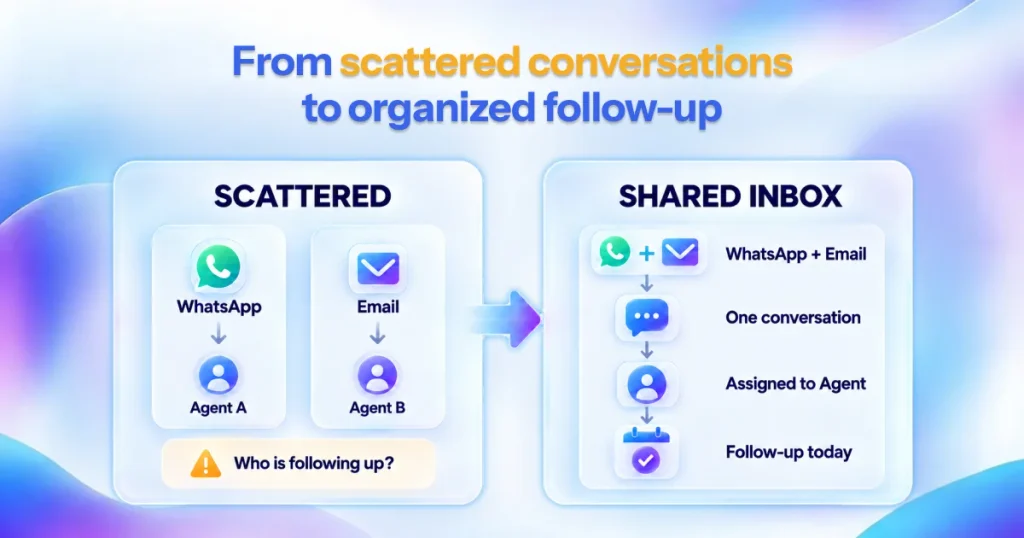
The way follow-up fails changes as the team grows. These team types are examples, not research thresholds.
| Team size | Typical risk | What needs to change |
| Solo agent | Forgotten follow-ups | A personal task system, with a next-action date on every lead |
| Small team | Unclear ownership | One assigned owner per lead, with cover when they are out |
| Growing team | Fragmented conversations | Shared visibility across channels, a handoff process, and a manager view of unassigned leads |
Here is how it fails: a buyer sends a property question on WhatsApp, and Agent A replies. Two days later, the same buyer emails the office. Agent B sees the email but cannot see the WhatsApp conversation, so Agent B asks questions the buyer already answered, or both agents reply with different answers.
The result is duplicate replies, missed follow-ups, confusing handoffs, and a buyer who wonders whether anyone is in charge.
When nobody clearly owns a lead, everybody assumes someone else replied.
A team needs six things in place:
- One owner per lead, assigned to the conversation, not just the contact
- Shared history across every channel the lead uses
- Internal notes for promises, preferences, and objections, hidden from the lead
- Handoff rules, so notes and history move with the lead
- Status labels and tags that everyone defines the same way
- A pending follow-up view, so overdue conversations are easy to find, for agents and managers
Shared Inbox vs CRM for Real Estate Lead Follow-Up
Teams often ask whether they need a CRM or a shared inbox. They do different jobs.
| CRM | Shared inbox | |
| Main job | Track leads and deals | Manage conversations |
| What it holds | Lead records, pipeline stage, deal value, forecasts | WhatsApp and email threads, replies, notes, ownership |
| Question it answers | “Where is this opportunity in the pipeline?” | “Who is handling this conversation, and what was said?” |
| Best for | Pipeline and sales reporting | Replies, handoffs, and shared context |
Many teams need both. A CRM tells you where the opportunity is in the pipeline. A shared inbox helps your team manage the conversations that move it forward.
How a Shared Inbox Makes Real Estate Lead Follow-Up More Consistent
Scattered conversations cause the ownership and context problems above. Agents use personal WhatsApp accounts, separate email inboxes, and notes in their heads, so each person sees part of the story.
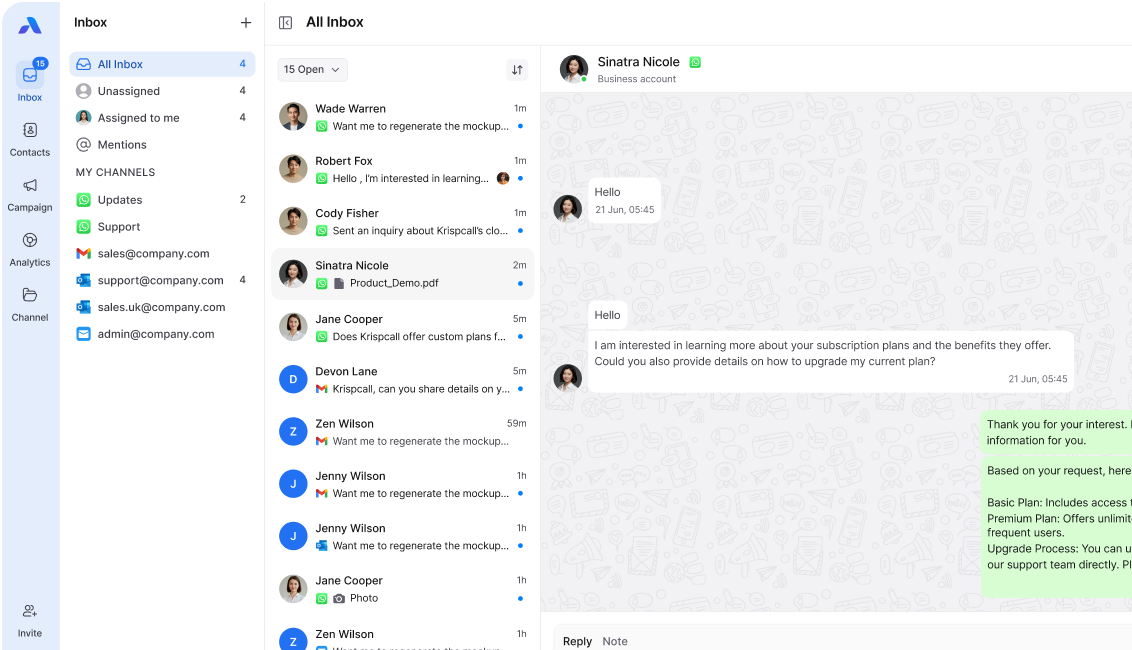
A shared inbox brings conversations from several channels into one workspace, so the team sees the full history and knows who owns each lead. AirChannel is a unified inbox that brings WhatsApp and email conversations into a shared team workspace.
It connects Gmail, Outlook, and IMAP accounts. For real estate teams, it maps to the follow-up problems in this guide:
- Property inquiry: WhatsApp and email inquiries land in one inbox, and the team assigns each conversation to an agent.
- Buyer follow-up: The agent sees the full history, adds an internal note about what the buyer wants, and tags the lead by status. Contact records keep buyer details next to the thread.
- Seller inquiry: The listing agent owns the conversation, with private notes on timeline and price expectations.
- Viewing request: Shared visibility shows who is handling the request, which helps avoid overlapping replies.
- Handoff between agents: The new agent reads the history and notes instead of asking the lead to repeat everything.
- Follow-up tracking: Tags and filters help agents find open and follow-up conversations by status, assignee, or priority. Quick reply templates keep answers to common property questions consistent.
- Team visibility: Managers can see who is handling what, plus response times and message volume in the analytics.
A shared inbox does not write your messages or set your process. You still need the REAL habits, a schedule, and usually a CRM for pipeline reporting.
Should You Call, Text, WhatsApp, or Email a Real Estate Lead?
Choose the channel based on the lead’s preference, the type of information, the urgency, the channel of the existing conversation, and whether you have permission to use it.
Call vs Text vs WhatsApp vs Email
| Channel | Best used for | Strength | Potential limitation | Example use case |
| Phone | Urgent or complex questions, qualifying | Personal, fast back-and-forth | Many people ignore unknown numbers | Confirming a showing with a hot lead |
| Text/SMS | Short updates, scheduling | Quick to read and answer | Poor for detail, and consent rules may apply | Sending a viewing reminder |
| Ongoing conversations, photos, quick questions | Familiar chat format, easy to share images and location | Works only if the lead uses it and expects your messages | Sending photos after a client asked | |
| Details, documents, longer explanations | Easy to save and search | Slower replies, and it may land in spam | Sending a buyer checklist or fee breakdown |
No channel wins every time. Switching channels can help when one is not working, such as moving from email to a quick call. Sending the same message on every channel at once feels intrusive.
In the US, the FCC says robocalls and robotexts to mobile phones generally need prior consent, and people can withdraw it in any reasonable way, such as replying “stop” (FCC guide). The FTC’s CAN-SPAM guide requires an opt-out in commercial email and says to honor requests within 10 business days. Rules vary by country, so check yours; this is general information, not legal advice.
What Should You Say in a Real Estate Follow-Up?
Adjust the names and details to fit the conversation.
Follow-Up Messages by Scenario
| Situation | Goal | Message approach | Example CTA |
| New inquiry | Answer the question and learn the timeline | “Hi Sara, the two-bedroom on Palm Street is still available, and parking is included.” | “Are you hoping to move this month or next?” |
| No response after first contact | Restart with something new | “Hi Sara, you asked about pets on Monday. The owner confirmed small dogs are fine.” | “Want to see it Thursday or Friday?” |
| After a showing | Get an honest reaction | “Thanks for viewing the Palm Street unit today. What did you like, and what felt off?” | “Should I line up a second viewing or send similar places?” |
| After sending property details | Move from information to action | “I sent the floor plan and fees earlier. Do those numbers fit your budget?” | “Would a short call help you compare it with the others?” |
| Price objection | Understand the limit and offer options | “Understood. What monthly budget feels comfortable?” | “Can I send two listings near that budget?” |
| “I’m still looking” | Stay useful and learn what is missing | “That makes sense. What have you seen so far that you liked or ruled out?” | “Want me to send listings like the ones you liked?” |
| “Not ready yet” | Respect their timing and keep the door open | “No problem. When do you expect to start looking again?” | “Should I send a short update once a month until then?” |
| Lead goes cold | Ask whether plans changed | “Hi Sara, it has been a few weeks since we talked about Palm Street.” | “Have your plans changed, or should I pause for now?” |
| Seller lead | Learn their reason and timeline | “Thanks for asking about selling. When would you like to be settled somewhere new?” | “Could I walk through the home this week to give you a price range?” |
| Buyer lead | Clarify criteria | “What matters most in your search: location, size, or budget?” | “Want me to send three matches by Friday?” |
| Re-engaging an old lead | Restart with relevant news | “Hi Sara, we spoke in March about buying near Riverside. Two new listings came up there this week.” | “Want details on either one?” |
How Do You Follow Up With a Lead Who Does Not Respond?
Silence does not always mean a lead has lost interest. It may mean the timing changed, they became busy, or their plans shifted. It can also mean they found another agent or do not want contact, so change your message each time and watch for signals.
- First follow-up: Refer to the original inquiry. “You asked about the Palm Street unit on Monday. It is still available.”
- Second follow-up: Add something new, like a similar listing, a price update, or an answer to a question they raised.
- Later follow-up: Ask whether their plans have changed, and offer to pause.
- Long-term: Move them into nurture instead of sending endless “checking in” messages.
Avoid repeating the same message, messaging too often, using guilt, pretending urgency or scarcity, sending listings that do not match their search, and sending the same message on every channel at once.
How Do You Follow Up Without Sounding Aggressive?
The difference is persistence versus repetition. Persistence means you keep giving the lead a new reason to reply. Repetition means you keep asking for the same thing.
Repetition: “Just following up again on my last message.”
Persistence: “The owner of the Palm Street unit just reduced the price. I thought you would want to know.”
Give the lead an easy way out (“Tell me if you would rather pause for now”), send one message per contact, and accept a “no” quickly.
Persistence adds value. Repetition adds noise.
How to Measure Your Real Estate Lead Follow-Up
Compare your numbers with your own baseline first. Skip industry benchmarks that come without a source and context.
| Metric | What it tells you |
| First response time | How long new leads wait for a first reply |
| Response rate | Share of leads that reply |
| Contact rate | Share you reach in a real conversation |
| Qualified lead rate | Share showing serious interest |
| Appointment or showing rate | Share that move to a viewing |
| Follow-up completion rate | Share of planned follow-ups that happen |
| Lead-to-client conversion rate | Share that become clients |
| Conversion by lead source | Which sources produce serious leads |
| Pending follow-ups | How many conversations are overdue |
| Unassigned leads | How many leads have no owner |
| Response time by team member | Where coaching or workload changes may help |
| Conversation volume | Whether the team can handle demand |
If you are starting from zero, track four: first response time, follow-up completion rate, unassigned leads, and lead-to-client conversion rate. Inbox analytics can show response times and message volume. Conversion metrics usually come from a CRM or a spreadsheet.
9 Real Estate Lead Follow-Up Mistakes to Avoid
- Waiting too long. Set a response goal, and cover evenings and weekends if leads arrive then.
- Sending generic messages. Name the property, area, or question.
- Asking too many questions at once. Ask one at a time.
- Following up without a reason. No news, no message.
- Using one cadence for every lead. Sort by hot, warm, and cold.
- Losing conversation context. Keep every channel and note in one place.
- Not assigning ownership. One named owner per lead.
- Giving up too early. Move quiet leads into nurture.
- Never measuring the process. Review response time and follow-up completion weekly.
The Difference Between Following Up and Actually Nurturing a Lead
Follow-up continues the conversation. Nurturing improves the relationship and helps the lead move closer to a decision over time.
Follow-up looks like this: a buyer asks about a property, and you send the answer and propose a viewing time. It responds to something the lead just did.
Nurturing looks like this: a buyer says they plan to buy in six months, so you send a short monthly note about that neighborhood with a couple of matching listings. You are not pushing for a decision. You are staying useful until they are ready.
Build Your Real Estate Lead Follow-Up System This Week
Start with three actions:
- Give every new lead one named owner and a recorded next follow-up date.
- Run your next five follow-ups through the REAL checks.
- Sort your current leads into hot, warm, and cold, and change the next action for each.
Real estate lead follow-up improves when the process is written down, visible, and shared.
Frequently Asked Questions
How do I follow up with leads?
Respond as soon as your team reasonably can, refer to the original inquiry, ask one question, share something useful, and propose one next step. Record the next follow-up date, and move leads who are not ready into nurture.
How quickly should I respond to a new real estate lead?
As soon as your team reasonably can. Research on online sales leads links faster responses with better lead qualification, though it was not specific to real estate. Set a target your team can meet, and track it.
How many times should I follow up with a real estate lead?
There is no universal number. Hot leads may need contact every day or two, warm leads every few days, and cold leads monthly or less. Stop if the lead asks you to.
What should I say when a real estate lead does not respond?
Refer to the original inquiry, then add something new, like a similar listing. Later, ask whether their plans changed and offer to pause. Avoid guilt and fake urgency.
How do you follow up with a lead without being aggressive?
Give each message a reason, ask for one thing, and offer an easy way out. Persistence adds something new each time. Repetition asks again with nothing new.
Should I call, text, WhatsApp, or email a real estate lead?
Use the channel the lead prefers and has agreed to. Calls suit urgent questions, texts and WhatsApp suit short updates, and email suits details and documents.
How do I follow up with a cold real estate lead?
Refer to your earlier conversation, share one relevant update, and ask whether plans changed. If they reply, restart active follow-up. If not, keep contact low, like a monthly market note.
How do I follow up after a real estate showing?
Message the same day. Ask what they liked and what felt off, then offer one next step: a second viewing, similar listings, or a call. Record their feedback.
What is the best way to organize real estate lead follow-up?
Give each lead one owner, a status, and a next follow-up date, and keep conversations and notes in one place. A CRM, a spreadsheet, or a shared inbox can work if the team uses it consistently.
How can a real estate team prevent leads from being missed?
Assign every conversation to a named agent, keep internal notes for handoffs, and bring messages from every channel into one place. Use tags and filters to see pending follow-ups, and review unassigned leads regularly.
Managing real estate leads across separate WhatsApp and email inboxes makes ownership and follow-up harder to track. AirChannel brings those conversations into one shared workspace so agents can see context, assign ownership, add internal notes, and keep follow-ups organized.