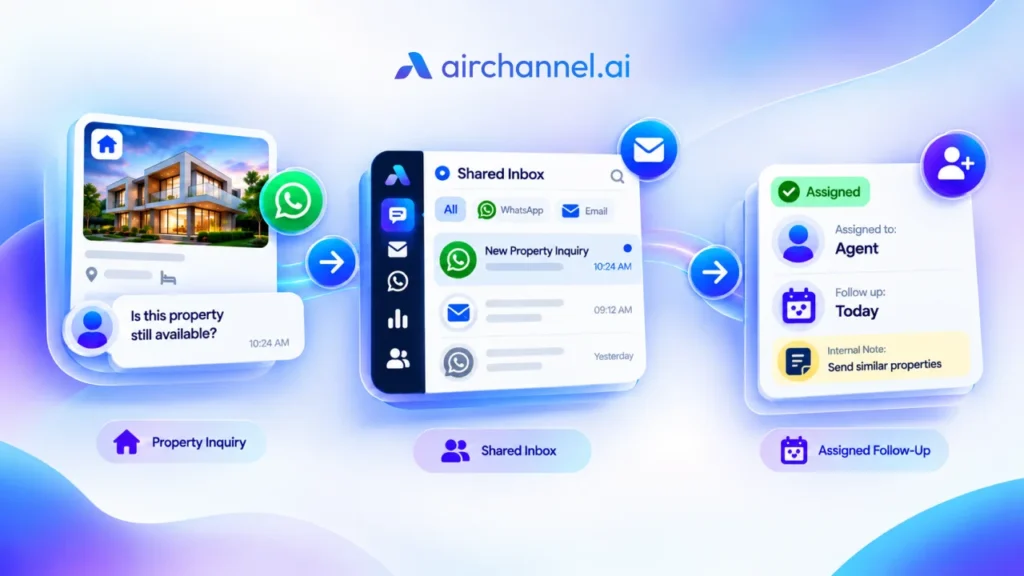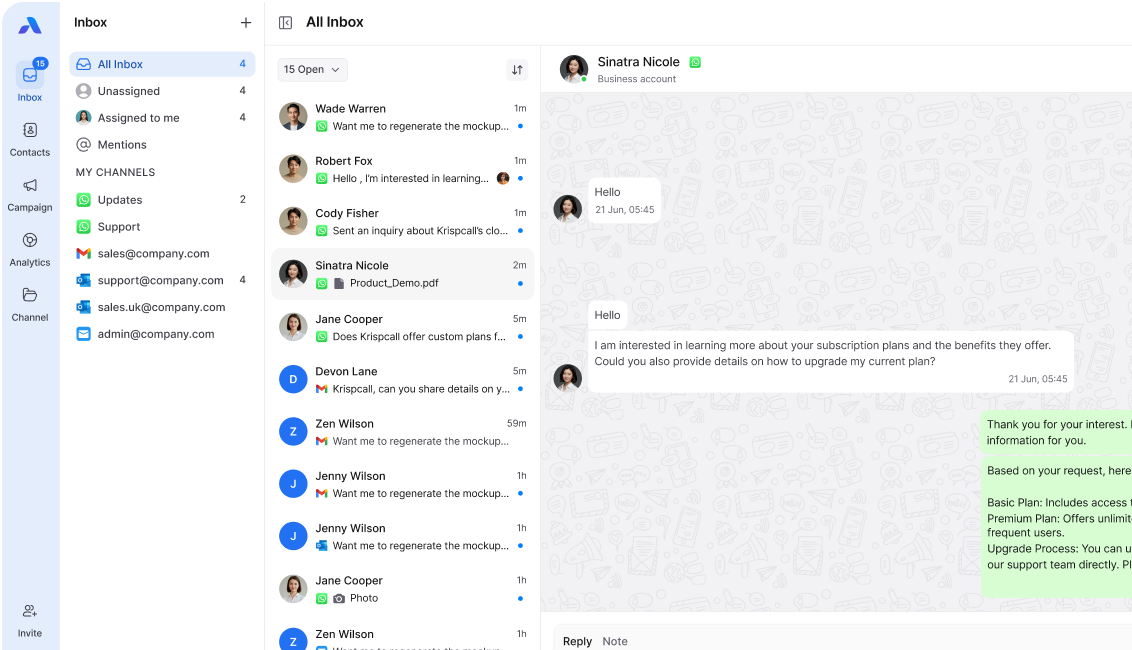
The goal is not to make every agent responsible for every conversation. The goal is to make every conversation visible to the right people while keeping responsibility clear. Some property teams don’t have a lead-generation problem. They have a follow-through problem. When inquiries are scattered across WhatsApp, email, and individual inboxes, some messages go unanswered or lose their context along the way.
Missing a property inquiry rarely looks dramatic. It looks like a WhatsApp message buried under twenty newer chats. It looks like an email that two agents assumed the other one would answer. More leads won’t fix a process that already loses track of the inquiries it receives.
Quick Answer: How Do You Manage Property Inquiries Without Missing Leads?
Property inquiry management means capturing every inquiry in one place, assigning it to a specific person, tracking its status, and following up until it reaches a clear outcome. You stop missing leads by building a process around five steps: capture every inquiry as it arrives, centralize conversations so the whole team can see them, assign each one to an owner, give every active inquiry a next action, and monitor which conversations are unanswered or overdue. Volume is not usually the problem. A missing process is.
Why Property Inquiries Get Missed
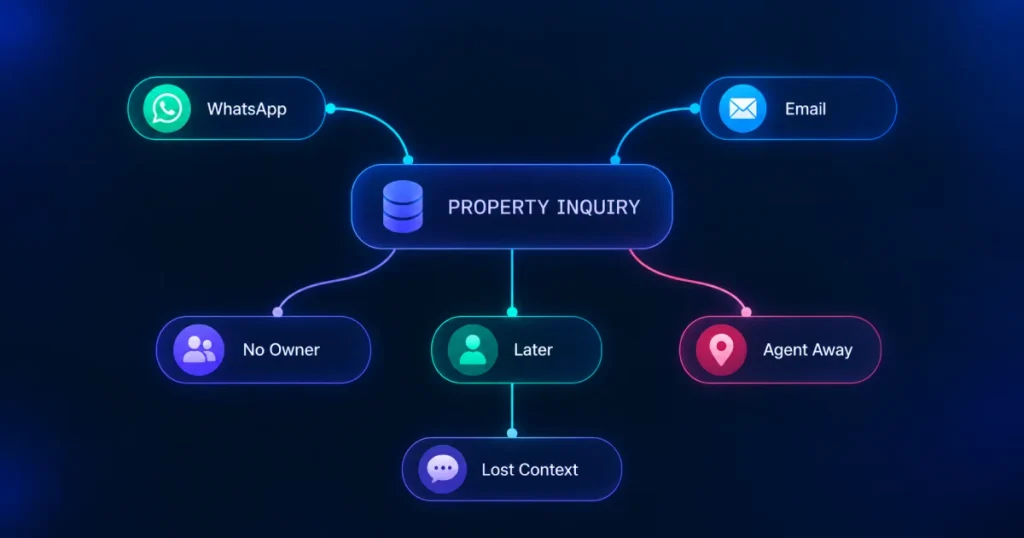
Missed inquiries are not always caused by careless agents. Often, the process itself makes it hard to see who owns a conversation or what needs to happen next.
Inquiries Come From Too Many Places
A buyer messages on WhatsApp. A seller fills out a contact form. A tenant replies to an old email thread. Each channel works fine on its own, but nobody has a single view of all of them together.
No One Clearly Owns the Conversation
When a message lands in a shared inbox or a general company number, ownership is often unclear. One agent assumes another is handling it. Nobody replies, because everyone thinks it is covered.
Follow-Ups Depend on Memory
“I’ll follow up later” is not a plan. It is a hope. Agents juggling a dozen active conversations cannot reliably remember which ones need a reply tomorrow and which ones can wait a week.
Agents Are Busy With Property Visits and Meetings
Real estate work happens away from a desk. Site visits, viewings, and client meetings pull agents out of their inbox for hours at a time. A message that arrives during a viewing can sit untouched until the agent resurfaces, and by then it is buried under newer chats.
Teams Cannot See What Others Are Handling
If a manager cannot see which conversations are active, stalled, or ignored, problems stay invisible until a prospect complains or goes silent. Visibility is what turns a pile of messages into a manageable pipeline.
Conversation Context Gets Lost
When an inquiry gets handed from one agent to another, the new agent often has to start from scratch. If prior messages, property preferences, or notes are not attached to the conversation, the buyer has to repeat themselves, and momentum is lost.
An inquiry without an owner is an inquiry at risk.
What Property Inquiries Actually Look Like
Generic lead management advice tends to blur every inquiry into one category. In practice, a buyer inquiry, a seller inquiry, and a tenant inquiry each need a different first move.
Buyer inquiry: “Is the 2-bedroom apartment still available?” The agent needs to confirm availability, understand the buyer’s budget and location needs, send matching options, and offer a viewing.
Seller inquiry: “I want to sell my apartment. Can someone contact me?” The agent needs to collect property details, identify whether a valuation is needed, assign the right agent for that area, and schedule a call or site visit.
Tenant inquiry: “Is this apartment available for rent from October?” The agent needs to confirm availability, collect the move-in date and budget, send relevant details, and offer a viewing.
The Property Inquiry Lifecycle
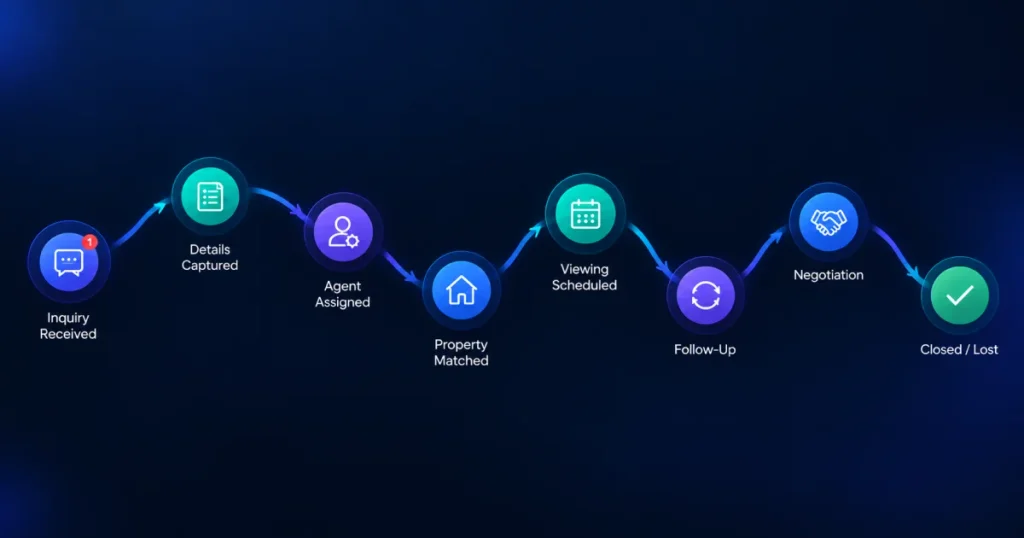
Every inquiry moves through the same general path, whether it comes from a buyer, seller, or tenant:
Inquiry arrives → requirement captured → agent assigned → lead qualified → property matched → viewing scheduled → viewing completed → follow-up → negotiation or nurture → closed or lost
The management problem is not simply moving a person from one stage to the next. It is making sure every stage has an owner and a next action. A stage with no owner is where inquiries quietly stall, regardless of how far along the lifecycle they are.
What to Ask When a Property Inquiry Arrives
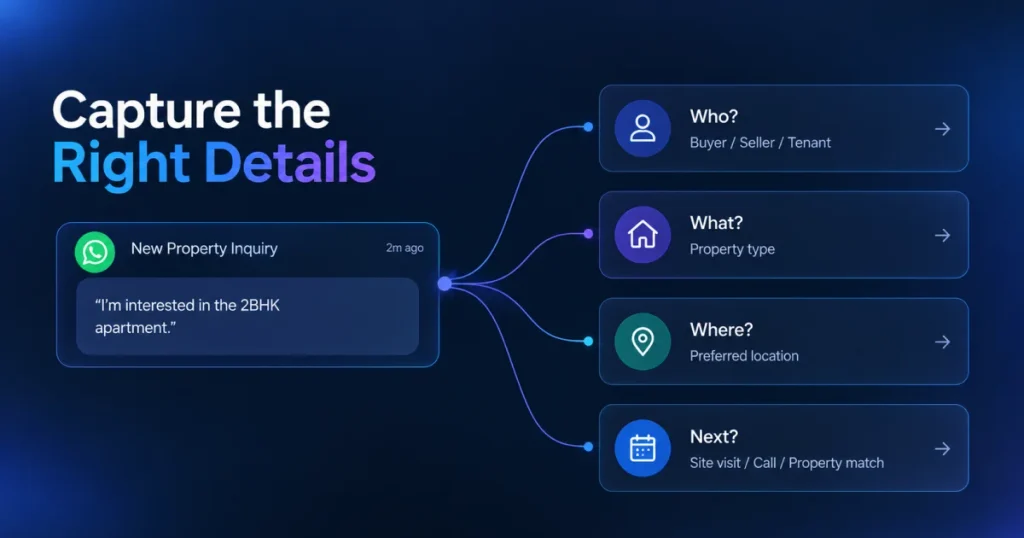
A short set of questions during the first conversation turns a vague message into a usable lead. What matters most depends on whether the person is buying, selling, or renting.
| Inquiry Type | Key Information to Capture | Next Action |
| Buyer | Budget, preferred location, property type, bedrooms, timeline | Match with available properties |
| Seller | Property location and type, ownership status, selling timeline | Assign an agent and schedule a valuation |
| Tenant | Budget, preferred location, property type, move-in date, household size | Confirm availability and offer a viewing |
Not every inquiry answers all of this right away. Getting even three or four of these details early gives the assigned agent enough to act on.
Property Inquiry Management: The 5-Step System
Fixing this does not require a complicated overhaul. It requires a defined system for what happens to every inquiry from the moment it arrives. Call it the 5-Step Property Inquiry Protection System.
1. Capture Every Property Inquiry
Every inquiry needs a destination the moment it comes in. That means knowing exactly where WhatsApp messages, emails, website form submissions, referrals, and portal leads are supposed to land. If the destination is unclear, the inquiry has already started slipping.
2. Centralize Your Conversations
There is a difference between a message being accessible and a message being visible to the whole team. An email sitting in one agent’s personal inbox is technically accessible. It is not visible to anyone else, which means nobody can cover for that agent or catch a missed reply.
3. Assign Every Inquiry to an Owner
Every inquiry should have exactly one person responsible for it. Assignment removes the guesswork of “is someone handling this.” It also makes handoffs clean when an agent goes on leave or gets pulled into a closing.
4. Give Every Active Inquiry a Next Action
A conversation without a next step tends to stall. Every active inquiry should have something defined waiting to happen, such as a follow-up call, a property match to send, or a viewing to confirm.
5. Monitor Unanswered and Overdue Conversations
Managers need a way to see which inquiries have gone unanswered, which are unassigned, and which follow-ups are overdue. Without that visibility, problems only surface when a prospect gives up and goes quiet.
Your team cannot manage what it cannot see.
Property Inquiry Workflow Table
| Inquiry Stage | What Should Happen | Owner | Next Action |
| New inquiry | Acknowledge receipt | Assigned agent | Understand the requirement |
| First response | Answer the initial question | Assigned agent | Qualify the lead |
| Qualified | Confirm budget, timeline, needs | Assigned agent | Match with properties |
| Property matched | Share suitable listings | Assigned agent | Schedule a viewing |
| Viewing requested | Confirm time and details | Assigned agent | Conduct the viewing |
| Viewing completed | Record feedback | Assigned agent | Decide next step |
| Follow-up needed | Contact prospect again | Assigned agent | Set a follow-up date |
| No response | Re-engage later | Assigned agent | Schedule next follow-up |
| Nurture | Keep inquiry active for future fit | Assigned agent | Review periodically |
| Closed or lost | Record the outcome | Assigned agent | Note reason |
Before and After: What Changes With a Defined Process
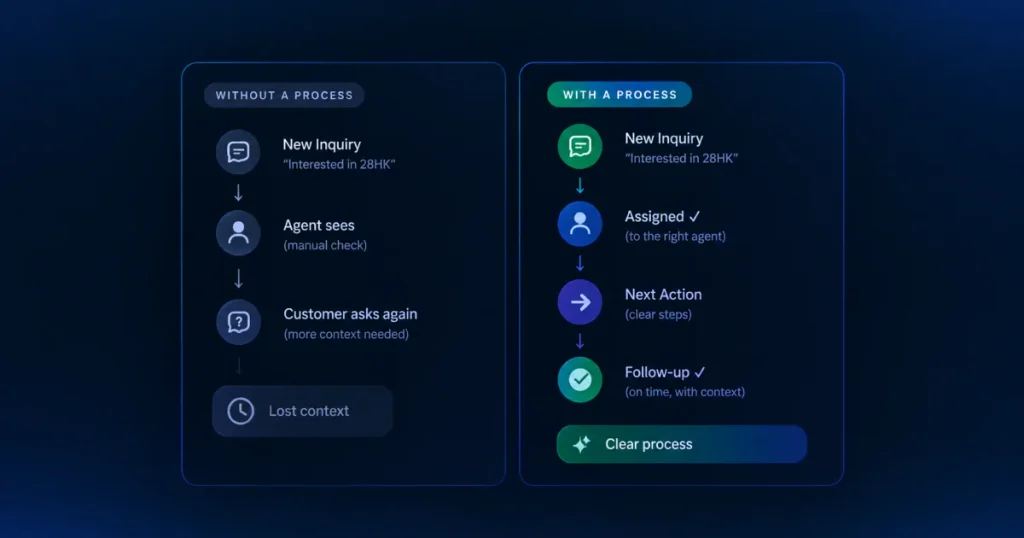
Without a defined process: a WhatsApp message arrives, an agent sees it and moves on, the agent forgets to follow up, the prospect messages again days later, a different agent replies without knowing the earlier conversation happened, and the context is lost.
With a defined process: the inquiry is captured, assigned to one agent, qualified using a short set of questions, given a next action, followed up on schedule, and its outcome is recorded, whether the deal closes or not.
The difference is not effort. It is structure.
How to Manage Property Inquiries When Agents Are Busy
Real estate work does not happen at a desk. Agents spend hours in viewings, site inspections, negotiations, and travel between properties. Expecting every inquiry to get a full, complete answer within minutes is unrealistic.
Split the response into three separate things: a fast acknowledgment, a complete response, and a follow-up. A quick acknowledgment tells the prospect they have been heard, even if it is a short message saying a full answer is coming soon. This buys time without leaving someone in silence.
Response speed does matter. Research published in Harvard Business Review by James Oldroyd and colleagues examined how quickly companies responded to web-generated sales leads, drawing on data from more than a million leads across dozens of companies. It found that response delays were common and that leads contacted quickly were substantially more likely to be qualified than leads contacted later. The study was not specific to real estate, but the operational point holds regardless of industry: leaving an inquiry unanswered for too long creates unnecessary risk.
If the assigned agent is unreachable, a visible, centralized inbox lets someone else send that acknowledgment or answer a simple question. The full response and ongoing relationship can still belong to the original agent.
How to Organize Property Inquiries From WhatsApp and Email
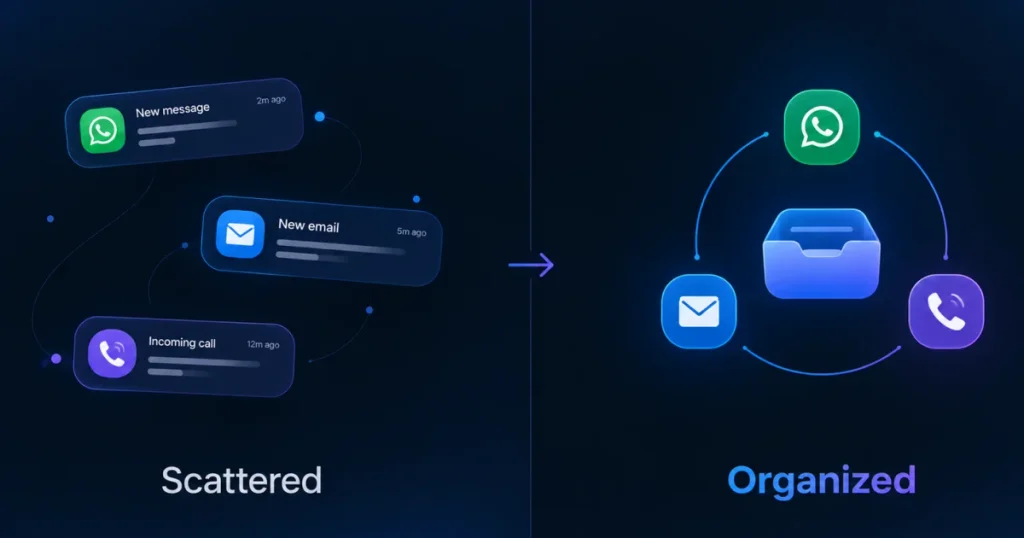
Picture a normal afternoon at a mid-sized agency. A buyer sends a WhatsApp message asking about a two-bedroom listing. At the same time, a seller emails the shared inbox asking for a valuation update. A third prospect replies to an old Outlook thread from a different agent entirely.
One agent is checking messages from their phone between viewings. Another is logged into the shared email account back at the office. Nobody is doing anything wrong, but nobody has the full picture either.
The problem is not that the team lacks communication tools. WhatsApp and email both work fine on their own. The problem is that the team lacks shared visibility across the two of them, which means an inquiry on one channel can go unnoticed by everyone except the one person who happened to see it first.
A shared inbox that brings WhatsApp and email into a single workspace closes that gap. Conversations from both channels sit in one place the whole team can see, so coverage does not depend on which app someone happened to have open.
What Should You Track in Property Inquiry Management?
Once inquiries are centralized and assigned, managers need a way to check the health of the pipeline. These are the indicators worth watching.
| Metric | What It Tells You | Why It Matters |
| Unanswered inquiries | Messages nobody has replied to | Shows leads at immediate risk |
| Unassigned conversations | Messages with no owner | Shows where ownership gaps exist |
| Overdue follow-ups | Promised next steps that did not happen | Shows where momentum stalled |
| Inquiry volume | How many inquiries arrive over time | Shows workload and channel trends |
| Inquiries by channel | Where inquiries come from | Shows which channels need attention |
| Inquiries by agent | Load per team member | Shows if work is unevenly spread |
| Response activity | Recent replies and actions taken | Shows the team is actively engaging |
None of these numbers need a benchmark to be useful. A rising count of unanswered or unassigned conversations is a signal on its own, regardless of what “normal” looks like for another team.
Why Your Real Estate Team May Not Have a Lead Problem
It is tempting to respond to a slow month by spending more on ads or chasing more referrals. Sometimes that is the right call. Often, though, the team already has enough inquiries coming in and is simply losing them along the way.
Inquiries get missed. Responses get delayed by a day or two. Follow-ups get forgotten once a message scrolls off the screen. Ownership is unclear, so nobody feels responsible for chasing it down.
Fast response means little if nobody follows up.
Before increasing lead-generation spend, check how many existing inquiries are being answered, followed up, and converted. Otherwise, more volume just gets added to a process that already has gaps.
Also check this article:
Real Estate Lead Follow-Up: How to Stay Consistent and Close More Opportunities
Missed Inquiry Audit: Find Where Leads Are Falling Through the Cracks
Answer these questions honestly for your team.
- Can we see every inquiry in one place?
- Does every inquiry have an owner?
- Can we tell who replied last?
- Can we see which conversations are unanswered right now?
- Can we identify overdue follow-ups?
- Can agents see the previous context before replying?
- Can managers see team workload across agents?
- Can we tell which inquiries need action today?
- Can someone take over a conversation without losing context?
- Do we have a defined process for handling a new inquiry?
If several of these answers are no, the issue is probably not lead volume. It is the process for managing the inquiries you already have.
When a Shared Inbox Makes Sense for a Real Estate Team
Not every team needs a dedicated tool for this. A single agent handling a handful of inquiries a week can often manage with a notebook and discipline. The calculation changes once a team has multiple agents, several communication channels, and a higher volume of inquiries moving through shared email accounts and WhatsApp numbers.
At that point, the signals are usually familiar: frequent handoffs, unclear ownership, follow-ups that fall through, and a manager who cannot easily see what is being missed. A shared inbox that brings conversations into one visible workspace is built for exactly that situation.
How AirChannel Helps Real Estate Teams Manage Property Inquiries
If your team is losing track of property inquiries because conversations are scattered across WhatsApp and email, AirChannel gives your team one shared workspace for managing those conversations.
It is worth separating two things here. The inquiry sources listed earlier in this article, such as contact forms, portals, and referrals, describe where property inquiries can originate in general. What AirChannel currently brings into a shared workspace is narrower and more specific: WhatsApp conversations alongside email accounts on Gmail, Outlook, and IMAP, all in one unified inbox the whole team can see.
From there, teams can use conversation assignment to give every inquiry a clear owner, add internal notes so context travels with a handoff, and apply tags and filters to prioritize what needs attention. Conversation history keeps previous messages available when another agent needs to take over, so a handoff does not require the prospect to repeat themselves. Real-time visibility and activity tracking give managers a way to see what is being handled and what is not.
AirChannel does not generate leads or replace the relationship-building part of real estate work. It gives a team a shared place to see, assign, and follow up on the inquiries they already have.
See How AirChannel Helps Real Estate Teams Manage Property Inquiries
Frequently Asked Questions
What is property inquiry management?
Property inquiry management is the process of capturing, tracking, assigning, and following up on every message a real estate team receives from buyers, sellers, tenants, or investors. It covers what happens to an inquiry from the moment it arrives until it reaches a final outcome, whether that is a closed deal or a recorded loss.
How do you manage property inquiries?
Capture every inquiry as it arrives, centralize conversations so the whole team can see them, assign each one to a specific owner, give it a defined next action, and monitor the pipeline for anything unanswered or overdue. The goal is a repeatable process rather than relying on individual memory.
How quickly should you respond to a property inquiry?
A fast acknowledgment matters more than an instant, complete answer. Letting a prospect know their message was received, even briefly, keeps the conversation warm while the assigned agent prepares a full response. The complete answer and any needed follow-up can come afterward.
How do you manage property inquiries from multiple agents?
Each inquiry needs a single assigned owner, even when several agents share the same inbox or WhatsApp number. A centralized view lets any agent see who is handling a conversation, which prevents duplicate replies and stops inquiries from being ignored because everyone assumes someone else has it.
How do you track which agent is responsible for a property lead?
Conversation assignment is the direct answer. When every inquiry is tagged to one specific agent inside a shared workspace, managers and teammates can see ownership at a glance instead of asking around or checking a personal phone.
How do you manage property inquiries from WhatsApp and email?
The main challenge is visibility across both channels rather than either channel individually. Bringing WhatsApp and email conversations into one shared workspace lets the whole team see and respond to inquiries regardless of which channel a prospect used.
What should a property inquiry tracking system include?
At minimum, it should show where an inquiry stands, who owns it, what the next action is, and whether a follow-up is overdue. A useful system also gives managers visibility into unanswered conversations and workload across agents.
When should a real estate team use a shared inbox?
A shared inbox becomes useful once a team has multiple agents, more than one communication channel, and enough inquiry volume that ownership and visibility start to break down. Smaller teams with light inquiry volume can often manage without one.
Conclusion
Start by auditing the inquiries your team receives today. Find the conversations without an owner, the follow-ups without a date, and the channels nobody checks consistently. Then build the workflow around those gaps: capture, centralize, assign, follow up, and monitor. The goal is simple. Every property inquiry should have a clear owner and a clear next action.
If conversations are scattered across WhatsApp and email right now, that is usually the first thing worth fixing. AirChannel gives real estate teams one shared workspace to manage those conversations without losing track of who owns what.