Introduction
You reply to every message you see. Your team works hard. Yet somehow, a customer still messages you asking why nobody replied.
This is more common than most business owners think. Customer conversations don’t disappear because people are careless. They disappear because of small, invisible cracks in how messages move through a business.
Businesses rarely lose customer messages because employees don’t care. They lose them because ownership becomes invisible as communication channels multiply. This guide breaks down exactly where those cracks form, how to spot the warning signs early, and what to fix before you spend money on new tools.
Quick Answer
Customer messages get lost when there is no clear system for receiving, assigning, and tracking conversations. This happens most often when businesses use multiple messaging channels without a shared view, when nobody owns a conversation clearly, or when follow-ups depend on memory instead of a process. The fix isn’t always more software. It’s usually a clearer workflow.
AI Overview Summary
Customer messages get lost mainly due to unclear ownership, scattered channels, and follow-ups that rely on memory instead of a system. As teams grow from one person to three or four people, communication complexity increases much faster than most businesses expect. Fixing the underlying workflow, not just adding another messaging app, is what actually stops messages from slipping through.
Why This Problem Is Bigger Than You Think
Most business owners notice missed messages only when a customer complains. By that point, the damage is already done. The customer feels ignored, and they rarely say so directly. They just quietly go somewhere else.
Growing support teams often discover this problem only after reviewing old chat threads and finding messages that were never answered. Nobody meant to ignore the customer. The message simply fell into a gap between two people, two tools, or two shifts.
One pattern we’ve consistently seen across growing customer support teams is that the problem gets worse, not better, right after the first hire. A solo founder answering every message has perfect ownership by default. The moment a second person joins, that clarity disappears unless someone deliberately rebuilds it.
The data backs this up. HubSpot research shows that most consumers rate an immediate response as important or very important when they have a sales question, and Salesforce’s State of the Connected Customer report found that roughly two-thirds of consumers now expect companies to interact with them in real time. When that expectation isn’t met, the consequences are severe. Zendesk data shows that well over half of consumers will switch to a competitor after a poor response time experience.
The hidden cost of a lost message isn’t just one unhappy customer. It’s the trust that customer never rebuilds, the referral that never happens, and the negative word of mouth that follows.
What you can do today:
- Ask your team honestly: “Do we know how many conversations are open right now?”
- Pull up your oldest unanswered message in every channel you use
- Write down who is responsible for each channel, even if the answer is “nobody yet”
The Customer Conversation Lifecycle
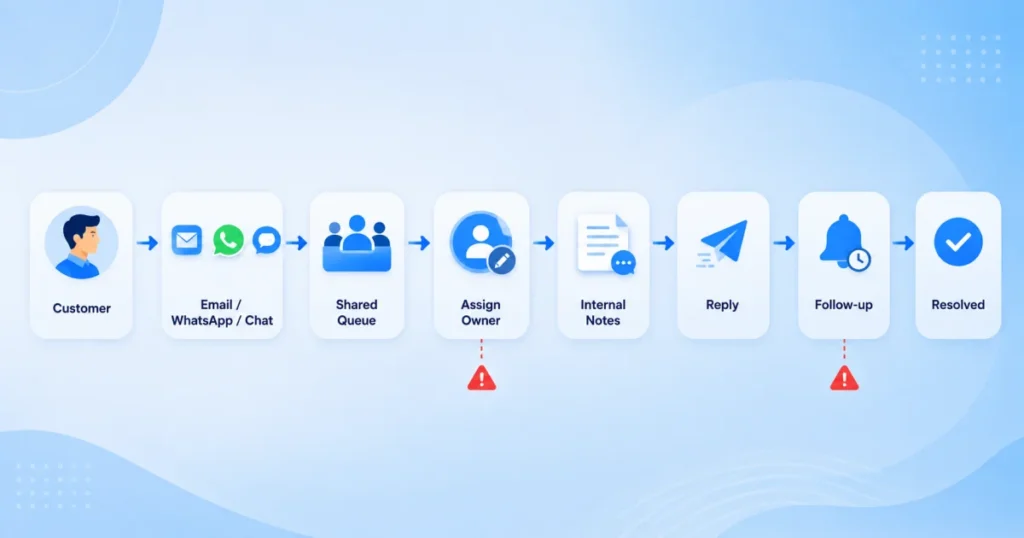
Every customer conversation moves through a series of stages, whether your team realizes it or not. Understanding this lifecycle is the single most useful thing you can do to find out where your messages are actually breaking down.
Customer → Email / WhatsApp / Live Chat / Website Form → Shared Queue → Review → Assign Owner → Internal Notes → Respond → Follow-up → Resolved → Monthly Review
Here’s what each stage actually means in daily operations, and where it tends to fail:
| Stage | What Should Happen | Where It Often Breaks |
| Channel Entry | Message arrives on email, WhatsApp, live chat, or a form | Each channel is checked separately, with no shared view |
| Shared Queue | All incoming messages land in one visible place | Messages stay trapped in individual inboxes or personal phones |
| Review | Someone reads and understands the request | Message is seen but not read carefully, or read too late |
| Assign Owner | A specific person takes clear ownership | No clear owner, so everyone assumes someone else has it |
| Internal Notes | Context and history are attached to the conversation | Notes live in someone’s memory or a separate chat entirely |
| Respond | The customer gets a helpful, timely reply | Reply is delayed, generic, or sent by someone without context |
| Follow-up | The team checks back if a promise was made | Follow-up depends on memory instead of a system |
| Resolved | The issue is fully and visibly closed | Conversation is left “open” with no clear end point |
| Monthly Review | The team learns from patterns across conversations | This step is skipped almost entirely in most businesses |
When auditing customer communication workflows, the biggest issues usually appear in the handoff stage, not the first response. Most businesses assume message loss happens right when the customer sends the message. In reality, it usually happens later, at “Assign Owner” and “Follow-up.” These are the two stages with the least visibility and the most reliance on human memory.
What you can do today:
- Draw this lifecycle on a whiteboard and mark where your team currently gets stuck
- Ask each team member which stage frustrates them most
- Pick one stage to fix this week instead of trying to fix everything at once
Where Are Your Customer Messages Breaking Down?
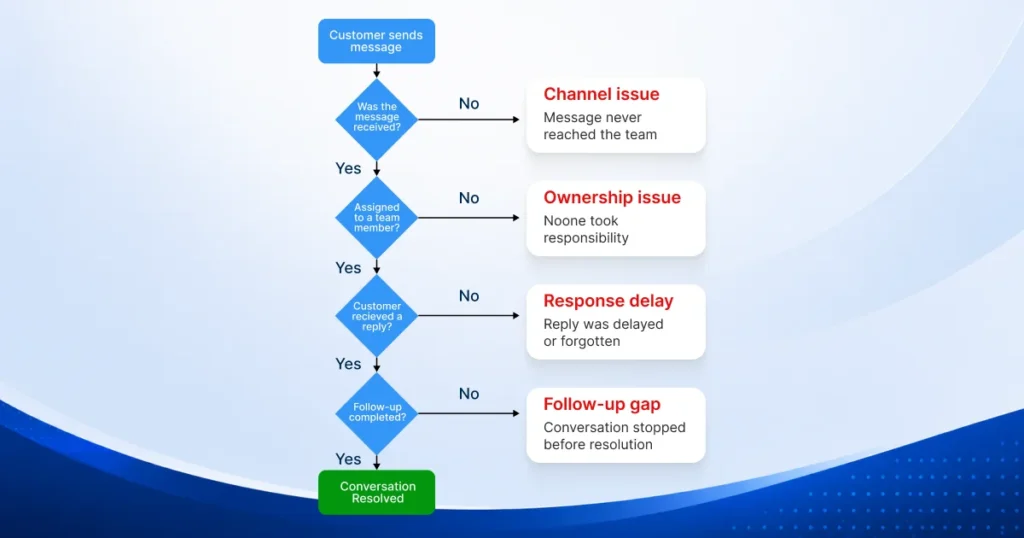
Use this simple decision tree to diagnose your own workflow. Walk through it with a real recent conversation in mind.
Customer sends a message ↓ Was it received and seen by someone on your team?
- If NO, you have a channel visibility problem. Messages are landing somewhere nobody checks.
- If YES, continue.
↓ Was the message assigned to a specific person?
- If NO, you have an ownership problem. This is the most common breakdown point.
- If YES, continue.
↓ Did the customer receive a timely response?
- If NO, you have a response time problem. Ownership exists, but speed is the gap.
- If YES, continue.
↓ Was a follow-up completed if one was promised?
- If NO, you have a process problem. The conversation likely stalled after the first reply.
- If YES, continue.
↓ Resolved.
Most businesses that run this exercise are surprised to find their weakest point isn’t the first response at all. It’s almost always ownership or follow-up. Knowing exactly which one lets you fix the right thing instead of guessing.
What you can do today:
- Pick three recent customer conversations and run each one through this tree
- Note which stage each one failed at
- Look for a pattern across all three
11 Reasons Customer Messages Get Lost
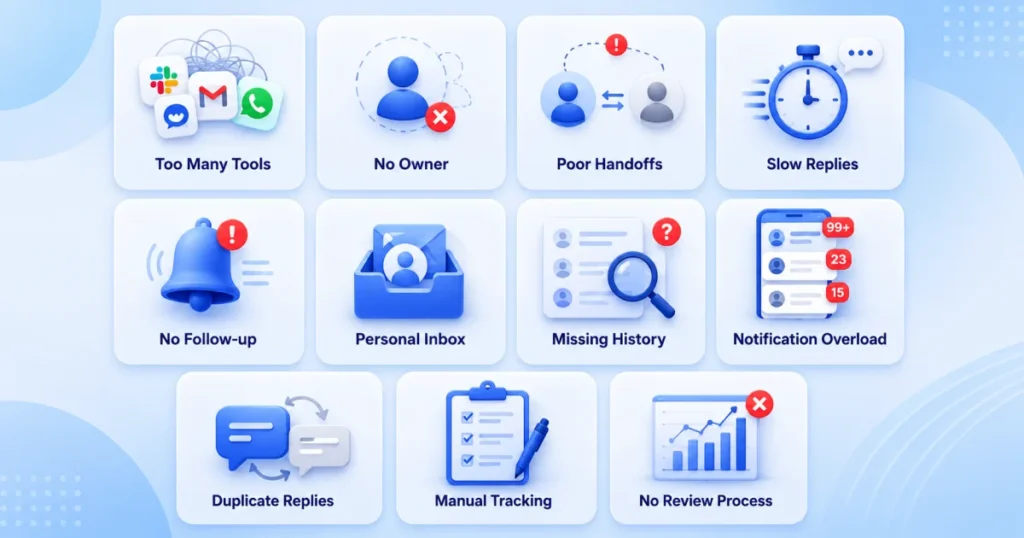
1. Messages Are Spread Across Too Many Channels
What happens: A customer messages you on WhatsApp, email, Instagram, and your website chat, sometimes all in the same week. Each channel has its own inbox, its own notifications, and its own history.
Why it happens: Businesses add new channels as customers request them, but rarely connect those channels together. Each new channel becomes its own island.
Business impact: A customer who switches channels looks like a brand-new conversation. The team loses context, repeats questions, or misses the message entirely because it landed somewhere unexpected.
How to improve: Map out every channel your customers actually use, then decide who checks each one and how often. Many teams eventually move toward a unified inbox for customer messages so every channel feeds into one place instead of ten.
2. No Clear Owner for Each Conversation
What happens: A message arrives, several people see it, and everyone assumes someone else will respond.
Why it happens: Without an assignment system, ownership is implied rather than confirmed. Implied ownership fails the moment two people are equally busy.
Business impact: This is one of the most common patterns across businesses, and it’s also one of the most damaging. A message can sit unanswered for hours simply because nobody claimed it.
How to improve: Every incoming message needs a named owner within minutes, not hours. A dedicated conversation assignment workflow removes the guesswork entirely by making ownership visible to the whole team.
3. Poor Handoffs Between Shifts or Team Members
What happens: A customer’s issue starts with one team member, but a shift change, sick day, or vacation moves it to someone new who has no context.
Why it happens: Handoff gaps occur when conversation history isn’t easy to find or isn’t documented at all. The new person starts from zero.
Business impact: Customers repeat themselves, get inconsistent answers, or feel like nobody remembers their issue. Trust drops fast when this happens more than once.
How to improve: Keep full conversation history attached to the customer, not the employee, so any team member can pick up where the last one left off.
4. No Internal Notes or Context Sharing
What happens: One team member learns something important about a customer, like a past complaint or a special request, but has no way to pass that on.
Why it happens: Most messaging apps aren’t built for internal collaboration. There’s no space to leave a note for the next person.
Business impact: The next response ignores context the customer already gave. This makes the business look disorganized, even if the actual work is solid.
How to improve: Use internal notes attached directly to the conversation, so context travels with the customer automatically instead of living in one person’s head.
5. Messages Get Buried Under High Volume
What happens: During busy periods, new messages push older ones down and out of sight.
Why it happens: Most inboxes are organized by time received, not by urgency or status. A message from three hours ago disappears under twenty newer ones.
Business impact: Older messages, often the most time-sensitive ones, are the ones most likely to be forgotten. The team ends up responding to whoever messaged most recently instead of whoever has been waiting longest.
How to improve: Sort and filter conversations by status, not just by time. Unanswered conversations should always stay visible, no matter how much new volume comes in behind them.
6. No System to Track Follow-Ups
What happens: A customer is told “we’ll get back to you,” and then nobody does.
Why it happens: Follow-through depends entirely on someone remembering a promise made in a busy conversation. Memory is not a system.
Business impact: Broken follow-up promises damage trust more than a slow first response. Customers remember being told something and then forgotten.
How to improve: Build a habit, or use a tool, that flags conversations needing a follow-up on a specific date.
7. Confusing “Read” vs “Resolved” Status
What happens: A message gets marked as read, and the team assumes it’s handled. It isn’t.
Why it happens: Most messaging tools only track whether a message was opened, not whether the customer’s actual problem was solved.
Business impact: Conversations quietly close themselves in everyone’s mind, even though the customer is still waiting for an answer.
How to improve: Separate “read” from “resolved” as two different statuses your team actively manages, so nothing gets marked done just because someone glanced at it.
8. Team Members Working in Personal Devices or Accounts
What happens: A staff member replies to a customer from their personal WhatsApp or personal email.
Why it happens: It’s often the fastest option in the moment, especially for small teams without a shared system.
Business impact: That conversation now lives on a personal device. If that employee leaves or is unavailable, the business loses the entire conversation history.
How to improve: Route every customer conversation through a shared inbox so history stays with the business, not with any one employee’s phone.
9. No Visibility Into Who Is Working on What
What happens: Two team members both reply to the same customer with different answers.
Why it happens: Ownership visibility is missing. Without a shared view, everyone works in their own silo.
Business impact: Customers get confused or contradictory answers, which damages confidence in the business fast.
How to improve: Give the whole team a shared, real-time view of every open conversation and its current owner.
10. Delayed Response Times Push Customers to Give Up
What happens: A customer waits so long for a reply that they simply stop messaging and go elsewhere.
Why it happens: Without clear response time targets, delays creep in slowly. Nobody notices until the customer is already gone.
Business impact: This is a silent loss. The business never even knows the message existed, because the customer never followed up a second time. HubSpot research found that 72% of customers expect a response within 30 minutes of reaching out, a bar many small teams don’t realize they’re missing.
How to improve: Set a realistic response time target, and track it consistently across every channel.
11. No Process for Reviewing Past Conversations
What happens: The same type of mistake happens again and again, because nobody looks back at what went wrong.
Why it happens: The “Monthly Review” stage of the conversation lifecycle is almost always skipped. Teams move on to the next message instead of learning from the last one.
Business impact: Communication problems repeat instead of shrinking over time.
How to improve: Set aside time monthly to review a sample of past conversations and spot recurring issues as part of a broader customer communication workflow.
Common Communication Bottlenecks
Beyond the 11 reasons above, a few patterns show up so often across industries that they deserve their own spotlight.
High message volume. A slow trickle of messages is easy to manage by instinct. A flood is not. Once volume crosses a certain point, informal habits stop working entirely.
Shift changes. Every handoff between people is a moment where context can be dropped. The more shifts a business runs, the more handoff points exist.
Vacation coverage. A single point of ownership works fine until that person is out. Backup coverage plans are often an afterthought, created only after something goes wrong.
Multi-channel conversations. A single customer issue that touches email, then WhatsApp, then a phone call, is really one conversation wearing three different disguises. Most systems treat it as three unrelated ones.
Poor ownership. Nearly every bottleneck above traces back to the same root cause. When ownership is unclear, every other problem becomes harder to catch and fix.
What you can do today:
- Identify which bottleneck above shows up most in your business
- Ask your team which one causes the most frustration day to day
- Address just that one bottleneck before trying to fix everything at once
Warning Signs Your Business Is Losing Messages
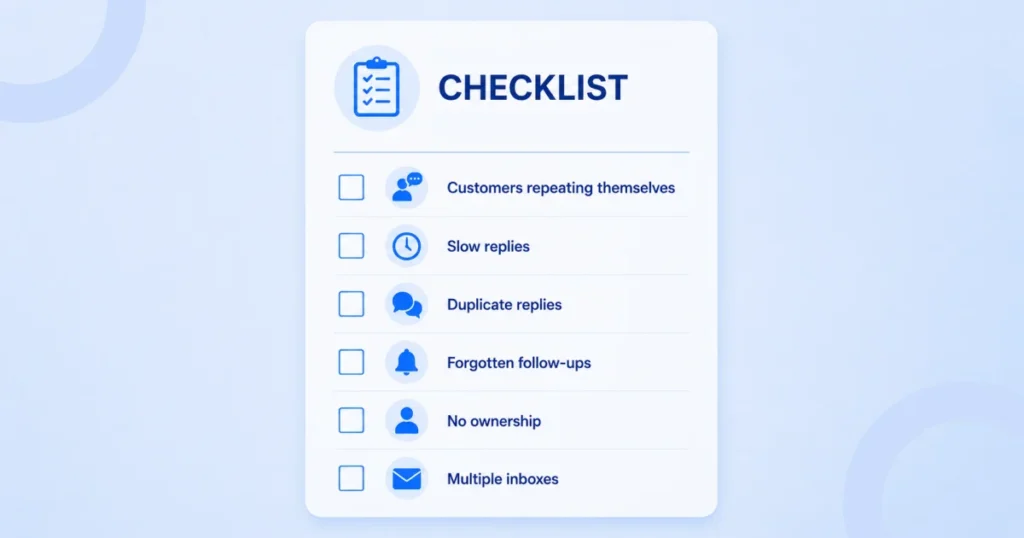
Use this checklist to spot early signs of message loss in your business.
- Customers ask “did you get my message?” more than once a month
- Different team members give different answers to the same question
- You’ve found an old, unanswered message while searching for something else
- Nobody can say for certain how many conversations are currently open
- Follow-ups depend on memory, not a system
- Team members check multiple apps to find one customer’s history
- You’ve lost a customer and later realized their message was never answered
If three or more of these sound familiar, message loss is likely already happening in your business.
Communication Health Scorecard
Rate your business honestly on each item below. Give yourself 1 point for each “yes.”
| Checklist Item | Yes / No |
| Every channel is checked on a set schedule | |
| Every message has one clear owner | |
| Conversation history is visible to the whole team | |
| Follow-ups are tracked, not remembered | |
| “Read” and “resolved” are treated as different statuses | |
| No customer conversations happen on personal devices | |
| The team reviews past conversations monthly |
Scoring:
- 6 to 7 points: Strong communication health
- 3 to 5 points: Moderate risk of lost messages
- 0 to 2 points: High risk, messages are likely already slipping through
Customer Revenue Leak Worksheet
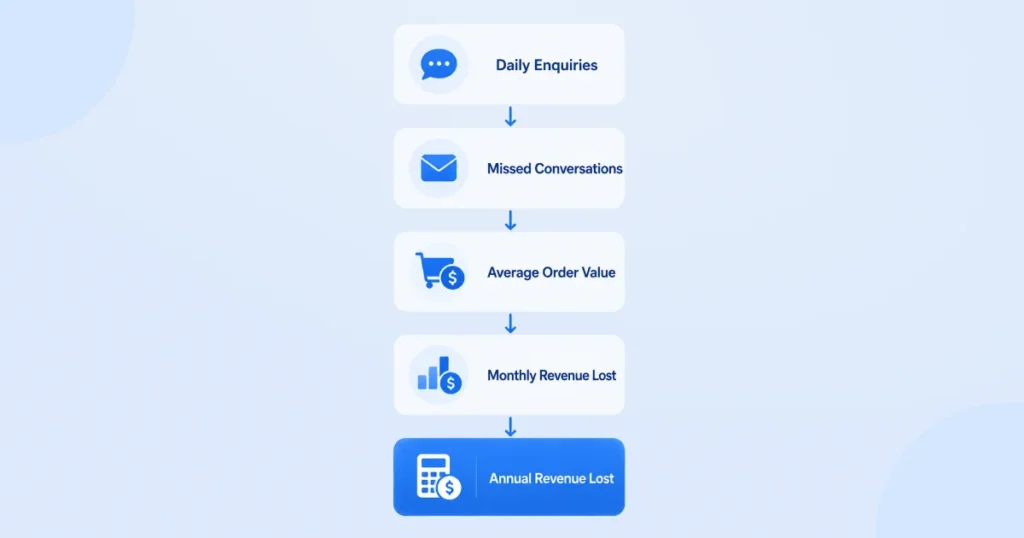
Missed messages don’t just feel bad. They cost real, calculable money. Work through each step below with your own numbers.
Step 1: Average enquiries per day: Count every new customer conversation you receive across all channels in a typical day.
Step 2: Average response rate: Estimate the percentage of enquiries that actually get a timely, complete reply. Be honest, not hopeful.
Step 3: Missed conversations Multiply enquiries per day by the percentage that don’t get a proper response. This is your daily leak.
Step 4: Average order value Use your typical order, booking, or contract value for a new customer.
Step 5: Estimated monthly revenue lost Multiply missed conversations per day by your close rate on properly handled leads, by your average order value, by roughly 30 days.
Step 6: Estimated yearly revenue lost Multiply your monthly figure by 12.
Worked example:
- Enquiries per day: 5
- Response rate: 80% (meaning 20% are missed)
- Missed conversations per day: 1
- Close rate on properly handled leads: 20%
- Average order value: $150
- Monthly revenue lost: 1 × 20 × 0.20 × $150 = $600 per month
- Yearly revenue lost: $7,200
Priority Score: If your yearly estimate is under $2,000, this is worth fixing but isn’t urgent. Between $2,000 and $10,000, this deserves attention in the next 30 days. Above $10,000, this is actively costing you enough to justify immediate process changes.
Interpret your number carefully. A worksheet like this will never be perfectly precise, but even a rough estimate usually reveals that the true cost of lost messages is higher than most teams assume.
Communication Maturity Model
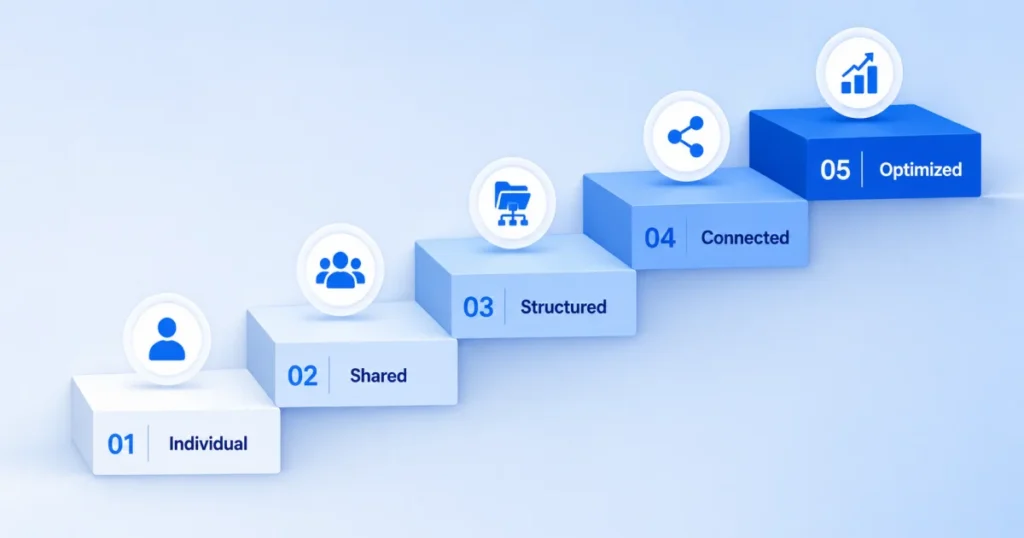
Most businesses fall somewhere on this five-level scale.
Level 1: Reactive No system. Messages are answered whenever someone happens to notice them.
Level 2: Aware The team knows the problem exists but has no formal process yet.
Level 3: Organized Clear ownership rules exist, but tracking is still manual.
Level 4: Systemized A shared system tracks ownership, follow-ups, and status automatically.
Level 5: Optimized The team actively reviews data and improves the process every month.
Most small and mid-sized businesses sit between Level 1 and Level 3. Moving up even one level significantly reduces lost messages.
What you can do today:
- Identify honestly which level your business sits at right now
- Pick the single habit that would move you to the next level
- Revisit this model again in 90 days to check your progress
Common Myths About Lost Messages
“We’re too small for this to happen.” Message loss often starts exactly when a business grows past one person handling everything. Two or three team members without a shared system is often riskier than one person with full ownership.
“Unread means unresolved, so we’re fine.” A message can be read and still not resolved. Many businesses confuse “seen” with “handled,” which is exactly how promises get forgotten.
“We’ll remember to follow up.” One common pattern across businesses is genuine intention followed by a busy day that erases the memory entirely. Memory is not a reliable system for anything customer-facing.
“WhatsApp is enough for our team.” WhatsApp works well for individual conversations, but it wasn’t built for team ownership, handoffs, or tracking who replied to what. A dedicated WhatsApp team inbox solves exactly this gap without asking customers to switch channels.
Reactive Workflow vs Organized Workflow
| Reactive Workflow | Organized Workflow |
| Personal inbox | Shared inbox |
| Memory | Assigned owner |
| Sticky notes | Internal notes |
| Multiple apps | Unified workspace |
| Unclear ownership | Assigned ownership |
| Manual follow-up | Follow-up tracking |
A personal inbox means conversation history disappears the moment an employee is unavailable. A shared inbox keeps that history with the business permanently.
Relying on memory for who owns what fails under pressure. An assigned owner removes the guesswork entirely.
Sticky notes get lost, thrown away, or forgotten on a desk. Internal notes attached to a conversation travel with it automatically.
Multiple apps force your team to hunt across platforms for one customer’s history. A unified workspace puts everything in one place.
Unclear ownership means everyone assumes someone else is handling it. Assigned ownership means everyone knows exactly who is responsible.
Manual follow-up depends entirely on someone remembering a promise. Follow-up tracking flags it automatically, whether anyone remembers or not.
Industry Examples: How This Plays Out Differently
SaaS
A growing SaaS company often splits support across a help desk tool, a sales inbox, and a founder’s personal email for VIP accounts. When a trial user asks a technical question through live chat and later emails about billing, the two conversations rarely connect. Support ends up asking questions the customer already answered, which is a fast way to lose a self-serve trial before it converts.
Real Estate
Real estate enquiries move fast and come from everywhere: a listing site, WhatsApp, a phone call, and a walk-in visit, sometimes all in one day. Agents who rely on personal phones to manage these leads often lose enquiries the moment they’re mid-showing with another client. By the time they check messages again, a competing agent has already responded.
Dental Clinics
Dental clinics juggle appointment requests, insurance questions, and emergency enquiries across phone, email, and increasingly WhatsApp. Front desk staff are often mid-conversation with a patient in the office when a message comes in, and there’s no clear rule for who checks the inbox next. A missed appointment request often isn’t discovered until the patient calls again, frustrated.
E-commerce
E-commerce brands frequently run customer service across email, Instagram DMs, and live chat at the same time, especially during sales periods. A customer asking about a delayed order on Instagram gets a different answer than the one they received by email an hour earlier, because neither channel shows the other’s history. During high-volume periods like holiday sales, this fragmentation multiplies fast.
Marketing Agencies
Agencies manage conversations with dozens of clients across email, Slack, and WhatsApp, often with several team members touching the same account. A client request that lands with an account manager who is out sick can sit untouched for days if there’s no backup owner assigned. The agency doesn’t find out until the client asks, pointedly, why nobody has replied.
What you can do today:
- Read the example closest to your industry and note which part feels familiar
- Ask whether your business has a backup owner for every important account or channel
- Write down the exact moment a message would fall through in your current setup
Mini Case Study: A Growing Home Services Business
Problem: A local home repair company started getting enquiries through Facebook, WhatsApp, and phone calls at the same time. Within a few months, customers began complaining that nobody responded to their initial message.
Root Cause: No one channel had a clear owner. The office manager checked Facebook, the technicians answered WhatsApp when they had time, and phone messages were written on paper notes that sometimes got lost entirely.
Solution: The business assigned one person to review all channels each morning and assign conversations by type. Follow-up reminders were added for any quote request older than 24 hours.
Business Improvement: Within two months, missed enquiries dropped noticeably, and the office manager reported far fewer “did you get my message” complaints. The fix wasn’t new software. It was a clear daily process.
Before You Buy Another Tool
It’s tempting to think a new app will solve message loss instantly. In most cases, it won’t, at least not on its own.
Adding another tool without fixing the underlying process just creates one more channel to lose messages in. The businesses that see real improvement fix ownership and follow-up habits first. Measuring service performance before investing in new software helps identify whether the real issue is process or capacity.
Software becomes genuinely useful once your team already understands where the gaps are. At that point, a tool doesn’t create the process. It simply makes an existing good process faster and easier to maintain.
Quick 30-Day Action Plan
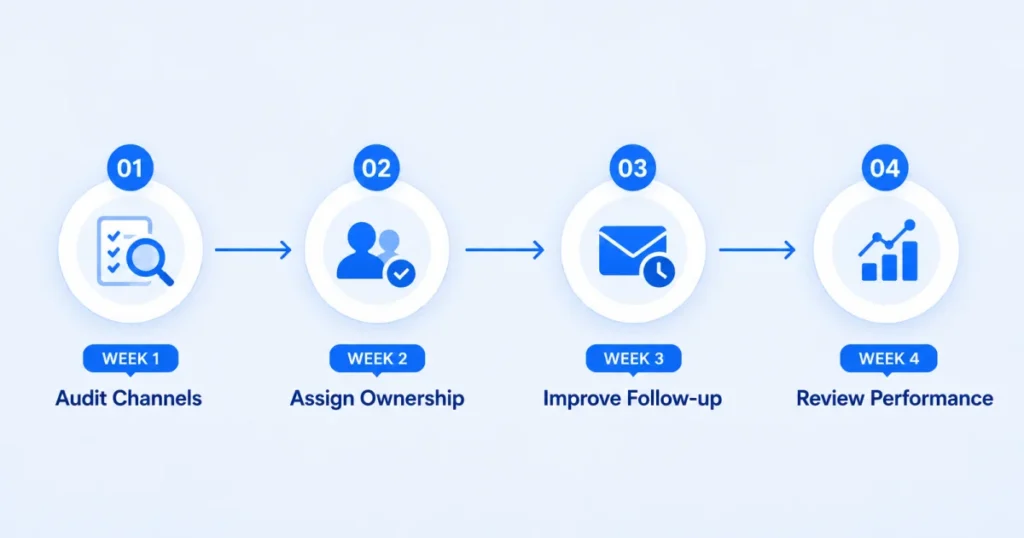
You don’t need a full software rollout to start seeing improvement. Here’s a simple month-long plan.
Week 1: Audit channels List every channel customers currently use to reach you. Identify which ones are checked regularly and which ones are neglected.
Week 2: Assign ownership Name one clear owner for each channel, and one backup owner in case the first is unavailable. Write this down where the whole team can see it.
Week 3: Improve follow-up Introduce a simple way to flag conversations that need a follow-up, even if it’s just a shared spreadsheet or calendar reminder to start.
Week 4: Review missed conversations Look back over the month and identify any conversations that slipped through. Discuss as a team what caused each one, and adjust your process accordingly.
What you can do today:
- Block time this week specifically for the Week 1 channel audit
- Share this 30-day plan with your team so everyone knows what’s coming
- Set a recurring calendar reminder for the Week 4 review, since this step gets skipped most often
When Technology Helps
Once your team has clear ownership rules and a real follow-up habit, a unified system for managing conversations can remove a lot of manual effort. This is where a customer communication platform that brings every channel into one place becomes genuinely useful, rather than just another app to check.
AirChannel is built around this idea: bringing WhatsApp, email, and other customer channels into one shared space, with clear assignment and visible conversation history. You can see exactly how it works and decide whether it fits where your team currently stands. It’s not a replacement for good process. It’s a way to make a good process easier to run every day. Also, you can look into one of our articles about the unified inbox guide to know basically what the unified inbox is about and how it works.
Key Takeaways
- Most lost messages don’t happen at first contact. They happen at “Assign Owner” and “Follow-up.”
- Unclear ownership is the single biggest cause of missed customer conversations.
- Small teams are often at higher risk than solo operators, not lower.
- Fixing your process matters more than adding new software.
- A shared, trackable system for follow-ups closes one of the most common gaps.
FAQs
Why do customer messages get lost?
Messages usually get lost because of unclear ownership, scattered channels, or follow-ups that depend on memory instead of a system.
How do I know if my business misses enquiries?
Watch for repeated “did you get my message” complaints, inconsistent answers from different team members, and old unanswered messages found by accident.
Can small businesses lose messages?
Yes. Message loss often starts as soon as more than one person is involved in customer replies, since ownership becomes less clear.
Is software the first solution?
No. Fixing ownership and follow-up habits should come before adding new tools, since software without a clear process just adds another place for messages to slip through.
How do I improve communication?
Start with the Communication Health Scorecard above, assign clear owners to every channel, and build a habit of tracking follow-ups instead of relying on memory.
Conclusion
Every customer message is an opportunity, whether it’s a first-time enquiry or a loyal customer with a simple question. Businesses don’t lose these opportunities because their teams don’t care. They lose them because communication isn’t designed to scale past one person’s memory.
The good news is that this is fixable, and it rarely starts with new software. It starts with knowing exactly where your messages break down, giving every conversation a clear owner, and building a habit of following through on what you promised.
If you want a simple way to bring every channel into one shared view once your process is ready for it, preventing lost customer messages is worth exploring as a next step.