A customer messages your business on WhatsApp. They ask about pricing. They are ready to buy.
Then nothing happens.
No one replies for six hours. By the time someone does, the customer already bought from a competitor.
This happens every day, in every industry. The problem is rarely WhatsApp itself. WhatsApp is fast, personal, and convenient for customers. The problem is what happens after the message arrives.
Most businesses don’t have a lead generation problem. They have a lead management problem. This guide breaks down exactly why businesses lose WhatsApp leads, what it costs you, and what you can fix starting today.
If you’ve noticed customers disappearing across more than just WhatsApp, our guide on why customer messages get lost explains the broader operational issues that affect every communication channel.
Quick Answer
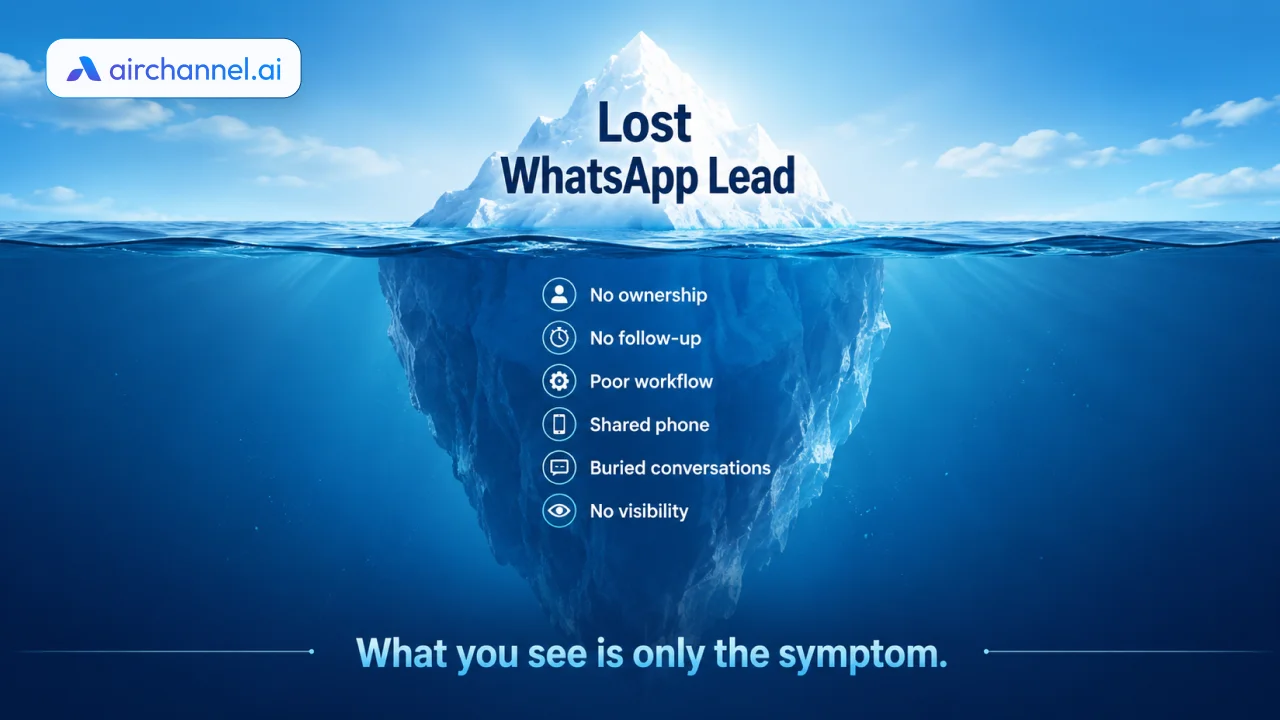
Businesses lose WhatsApp leads because of operational gaps, not because WhatsApp is ineffective. Slow response times mean high-intent customers move on before anyone replies. Without clear conversation ownership, messages sit unanswered because everyone assumes someone else will respond. Missing follow-up lets warm leads go cold, and buried conversations get lost inside crowded inboxes. As business growth increases message volume, manual workflows break down, causing missed and duplicate replies. Improving these operational workflows usually creates more revenue than generating additional leads.
Why do businesses lose WhatsApp leads?
Businesses lose WhatsApp leads when replies are slow, no one owns the conversation, or messages get buried in a crowded inbox. Without a follow-up process, high-intent customers move on quickly. As conversation volume grows, manual management breaks down, leading to missed messages, duplicate replies, and lost revenue. Before investing in new software, it’s worth learning how businesses can stop missing customer inquiries by improving ownership, response times, and follow-up processes.
Why WhatsApp Is One of the Best Channels for Business Leads

WhatsApp leads convert well because the intent behind them is already high.
A customer who messages you on WhatsApp usually took an extra step. They saw your ad, visited your website, or got your number from a friend. Then they chose to type a message instead of just scrolling past.
That single action signals real interest.
WhatsApp also removes friction. There’s no form to fill out, no account to create, and no hold music. Customers expect a fast, human response, similar to texting a friend. According to WhatsApp Business, customers increasingly use messaging to ask questions, request quotes, and communicate with businesses in a fast and familiar way.
This is exactly why losing a WhatsApp lead hurts more than losing a cold email lead. The customer already showed up ready to talk. Your business just wasn’t ready to answer. Businesses handling conversations across multiple channels often benefit from a unified inbox, which keeps customer conversations organized in one place instead of scattered across different apps.
The Hidden Cost of Losing WhatsApp Leads

A missed WhatsApp message doesn’t feel like a big deal in the moment. One unread chat. One late reply. It seems small.
But the cost adds up in ways most businesses never measure.
- Lost revenue. Every unanswered high-intent conversation is a sale that likely went elsewhere.
- Wasted ad spend. If you paid for a click that turned into a WhatsApp message, and that message went unanswered, you paid for a lead you never used.
- Damaged trust. Customers remember slow or ignored replies. Many won’t message you again.
- Team frustration. When no one owns conversations, employees start guessing who is responsible, and mistakes multiply.
None of this shows up on a sales dashboard directly. It shows up quietly, as lower conversion rates and unclear reasons why.
Lead Leakage Heatmap
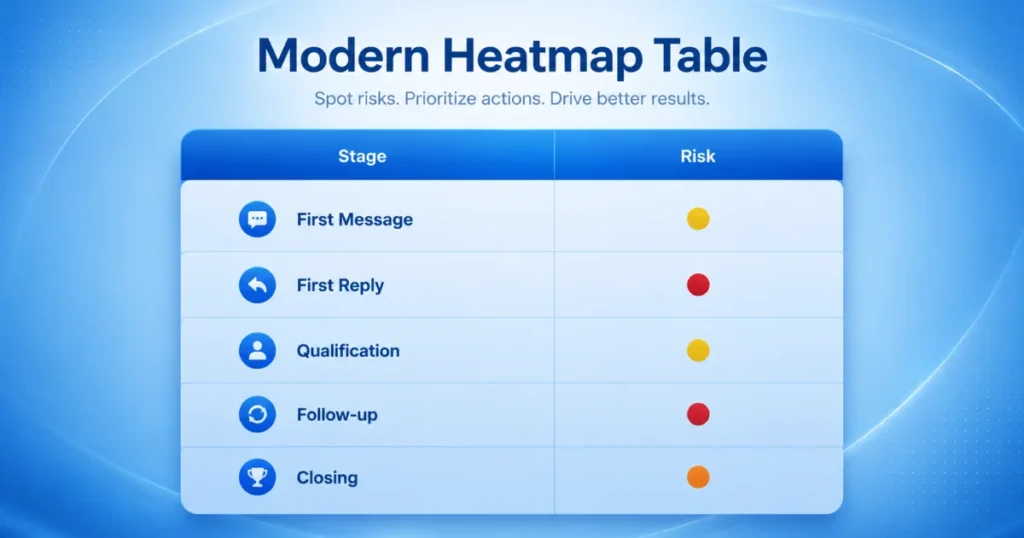
[Visual placeholder: a heatmap graphic showing risk level at each stage of a WhatsApp conversation, with warmer colors marking higher-risk stages.]
| Customer Journey Stage | Risk Level | Typical Cause | Business Impact |
| First Message | High | Message arrives in a shared or unmonitored inbox | Customer may already contact a competitor before anyone sees it |
| First Reply | High | No one is responsible for replying quickly | High-intent leads look elsewhere within minutes |
| Qualification | Medium | Context gets lost when different staff members reply | Customers repeat themselves and lose trust in the process |
| Follow-up | High | No scheduled check-in after the first reply | Warm leads go cold and never convert |
| Closing | Medium | Delays and duplicate replies create friction late in the process | Deals stall or fall through after most of the work is done |
Response time and follow-up consistently cause the most lead leakage, more than any other stage. Industry research from the Salesforce State of Service report highlights that speed and consistent communication remain key drivers of customer satisfaction and loyalty. A slow first reply pushes high-intent customers toward competitors within minutes, while a missing follow-up lets warm leads cool before a business reaches back out. Qualification and closing issues matter too, but they only affect leads that already survived the first two stages. Fixing response time and building a reliable follow-up habit typically recovers more leads than any other single change a business can make.
A Day in the Life of a Lost WhatsApp Lead
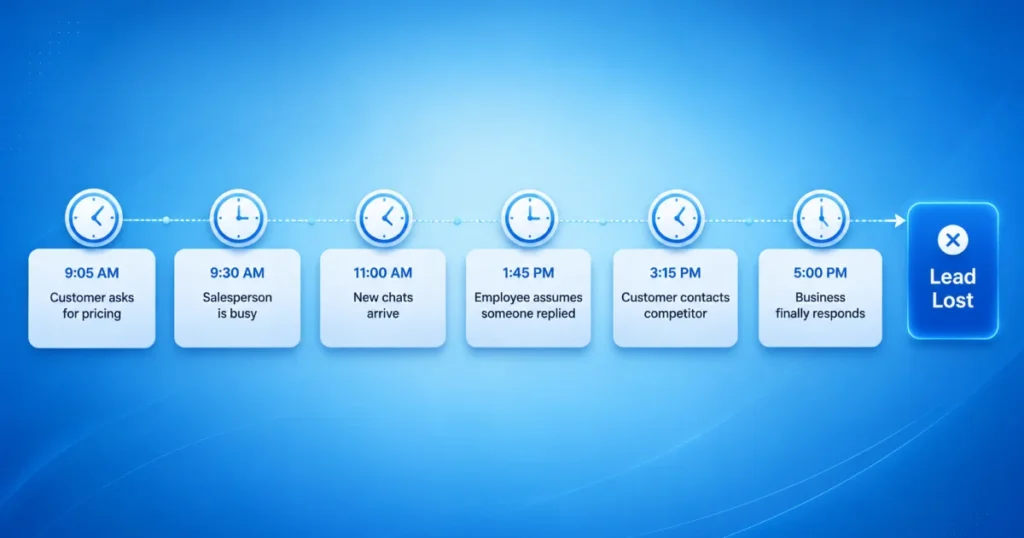
9:05 AM Customer asks for pricing
↓ 9:20 AM Salesperson is in a meeting
↓ 10:30 AM More WhatsApp inquiries arrive
↓ 12:15 PM Employee assumes someone already replied
↓ 2:45 PM Customer contacts competitor
↓ 5:00 PM Business finally responds
↓ Lead lost
By the time the business responds, five small delays have already stacked on top of each other: a meeting, a busy morning, a wrong assumption, and hours of silence. None of these felt like a big decision in the moment. Together, they cost the sale. This is how most WhatsApp leads disappear, not through one obvious mistake, but through several ordinary delays adding up over a single day.
9 Reasons Businesses Lose WhatsApp Leads
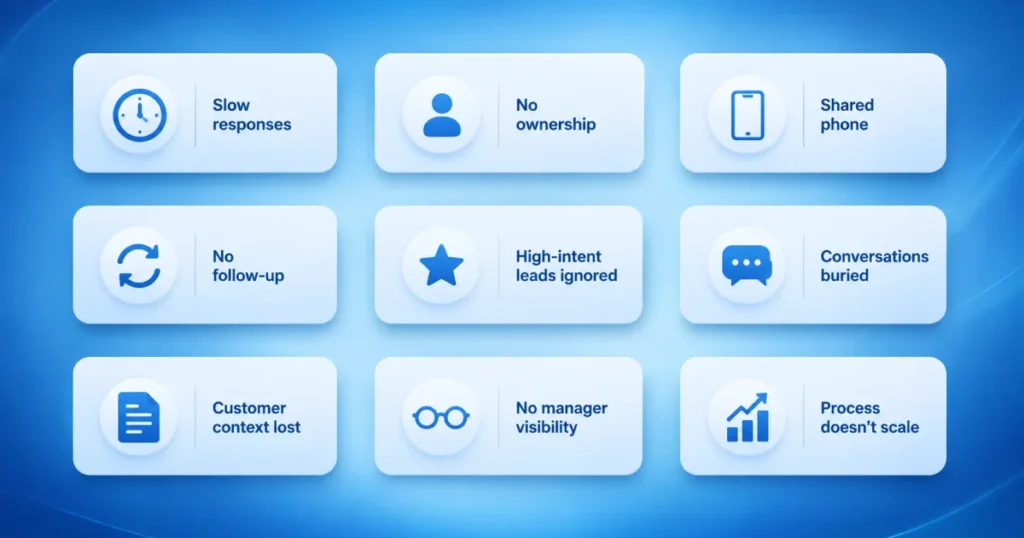
1. Slow Response Times
Why it happens: Messages pile up in one inbox, and no one checks it consistently throughout the day.
Real business example: A real estate agency gets 40 WhatsApp inquiries a day about listings. Agents only check the phone between showings, so replies often come 4 to 5 hours late.
Business impact: Buyers move fast. A slow reply means they’ve likely already contacted another agency by the time you respond.
Quick fix: Set a maximum response time goal, like 15 minutes during business hours, and assign someone to monitor incoming messages in shifts.
2. No One Owns the Conversation
Why it happens: Without clear conversation ownership, everyone assumes someone else will reply.
Real business example: A retail store shares one WhatsApp number across three staff members. A customer asks about stock availability, and each staff member assumes a coworker already answered.
Business impact: The customer gets no reply at all, even though multiple people saw the message.
Quick fix: Assign each new conversation to one specific person the moment it comes in, so accountability is clear.
3. Multiple Employees Share One Phone
Why it happens: Many small businesses run WhatsApp Business from a single physical phone, passed between staff.
Real business example: A healthcare clinic uses one phone for appointment requests. When the receptionist is on a call, the phone sits untouched, and messages wait.
Business impact: Only one person can access conversations at a time, creating a bottleneck as the business grows.
Quick fix: Separate access from a single device by giving your team shared, simultaneous access to the same WhatsApp number and conversation history. This is where a WhatsApp Team Inbox becomes useful, allowing multiple employees to work from the same business number without passing around one phone.
4. No Follow-Up Process
Why it happens: Teams reply once, then forget to check back if the customer goes quiet.
Real business example: An education consultancy answers a parent’s question about course fees but never follows up when the parent doesn’t respond within a day.
Business impact: Many leads need two or three touches before they decide. Without follow-up, warm leads go cold.
Quick fix: Build a simple follow-up rule, such as checking back after 24 hours if a customer hasn’t replied.
5. High-Intent Leads Aren’t Prioritized
Why it happens: All messages sit in the same inbox with no way to tell urgent leads from casual questions.
Real business example: An agency handling client inquiries treats a message asking “what do you charge for logo design?” the same as a general “hello” message, and replies in the order received.
Business impact: High-intent WhatsApp leads, the ones closest to buying, wait behind low-priority messages.
Quick fix: Create a quick tagging habit, like marking pricing or booking questions, so your team replies to the most valuable conversations first.
6. Important Conversations Get Buried
Why it happens: Once a chat list fills with dozens of threads, older or unread messages get pushed down and forgotten.
Real business example: A retail brand running a weekend sale sees a spike in messages, and yesterday’s unanswered inquiries get buried under today’s flood of new chats.
Business impact: Unread messages get left behind, even when the customer is still waiting.
Quick fix: Regularly sort conversations by unread status and follow a rule that no unread message sits untouched overnight. As message volume increases, many businesses switch to a shared inbox so unread conversations remain visible to the entire team instead of being hidden on one device.
7. Customer Context Gets Lost
Why it happens: When a different employee replies each time, no one remembers what was already discussed.
Real business example: A customer tells one agent about their budget and needs. The next day, a different agent replies and asks the same questions again.
Business impact: Customers feel like they’re starting over each time, which damages customer trust and slows down the sale.
Quick fix: Keep internal notes on each conversation so any team member can pick it up with full context.
8. Managers Have No Visibility
Why it happens: Without a shared view of conversations, managers can’t see how many messages are open, answered, or ignored.
Real business example: A growing agency’s founder only learns about a string of missed leads when a client complains directly, weeks after the fact.
Business impact: Problems go unnoticed until they’ve already cost the business customers.
Quick fix: Set up a simple weekly review of open and unanswered conversations, even a manual one, until better tools are in place.
9. Manual Processes Don’t Scale
Why it happens: What works for 10 messages a day breaks down at 100 messages a day.
Real business example: A business that started with one person managing WhatsApp now has a five-person sales team, all still fighting for access to a single phone.
Business impact: As conversation volume grows, manual processes create more missed messages, not fewer.
Quick fix: Recognize the growth point early, and start planning a workflow that supports more people and more volume.
Is Your Business Losing WhatsApp Leads?
Use this quick scorecard to check your risk level. Give yourself 1 point for every statement that is true for your business.
WhatsApp Lead Health Score
- Messages are answered within 15 minutes during business hours.
- Every conversation has one clear owner.
- More than one person can access the WhatsApp inbox at the same time.
- There’s a written follow-up process for leads who go quiet.
- High-intent messages get replied to before general questions.
- Unread messages are checked and cleared daily.
- Notes on customer context are saved and visible to the whole team.
- A manager can see open and unanswered conversations at a glance.
Score 7 to 8: Your process is solid. Focus on maintaining consistency as you grow.
Score 4 to 6: You’re likely losing some leads. Fix the weakest points first.
Score 0 to 3: You are likely losing WhatsApp leads regularly, and it’s affecting revenue.
What You Can Improve Before Buying Software
Before looking at any tool, it helps to look at three areas: people, process, and tools.
People
Make sure someone is clearly responsible for WhatsApp during every working hour. Ownership prevents messages from falling through the cracks.
Process
Write down your response time goal, your follow-up rule, and how you prioritize high-intent leads. A process that lives only in someone’s head disappears when that person is busy or leaves.
Tools
Software should support a good process, not replace one. A shared inbox or WhatsApp Team Inbox can make an existing process faster and more visible, but it won’t fix a business that has no process at all.
Get the people and process right first. Then let tools remove the manual work.
Business Stage Comparison
| Business Size | Biggest Risk | Priority Improvement |
| Solo | Messages get missed while handling other tasks | Set a maximum response time goal |
| 2–5 employees | Unclear ownership of conversations | Assign each conversation to one person |
| 5–20 employees | Manual tracking starts to break down | Write down a repeatable lead process |
| 20+ employees | Managers lack visibility into replies | Add regular reporting and audits |
People • Process • Tools Framework
[Visual placeholder: a simple vertical diagram showing three stacked blocks, People at the top, Process in the middle, Tools at the bottom, connected by downward arrows.]
| People | Process | Tools |
| Conversation ownership | Response time goals | Shared inbox |
| Accountability | Lead qualification | Conversation assignment |
| Team training | Follow-up workflow | Internal notes |
| Clear coverage during working hours | Escalation process | Reporting and visibility |
Software supports strong processes. It doesn’t replace them. A shared inbox only helps if someone already owns each conversation, a follow-up habit already exists, and a response time goal is already in place. Get people and process right first, and tools will simply make the work faster, not fix a workflow that was never built.
When Manual WhatsApp Management Stops Working
Every growing business hits a point where manual WhatsApp management breaks down. Watch for these signs:
- More conversations. Message volume grows faster than your team’s ability to track it manually.
- More employees. Multiple people need access, but WhatsApp Business wasn’t built for team collaboration.
- Poor visibility. Managers can’t tell what’s been answered without asking staff directly.
- Duplicate replies. Two team members respond to the same customer, creating confusion.
- Missed conversations. Messages get buried, forgotten, or never assigned to anyone.
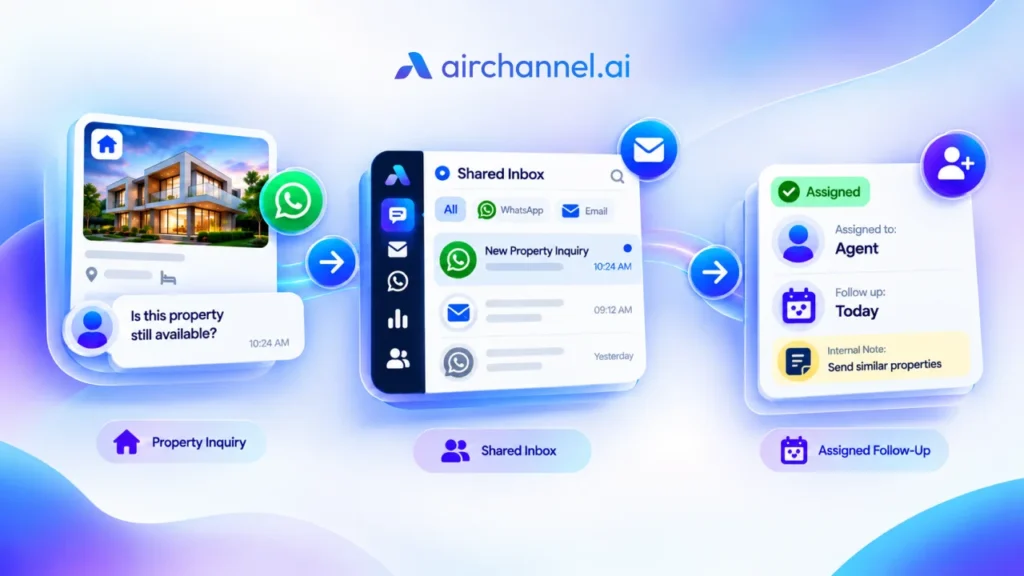
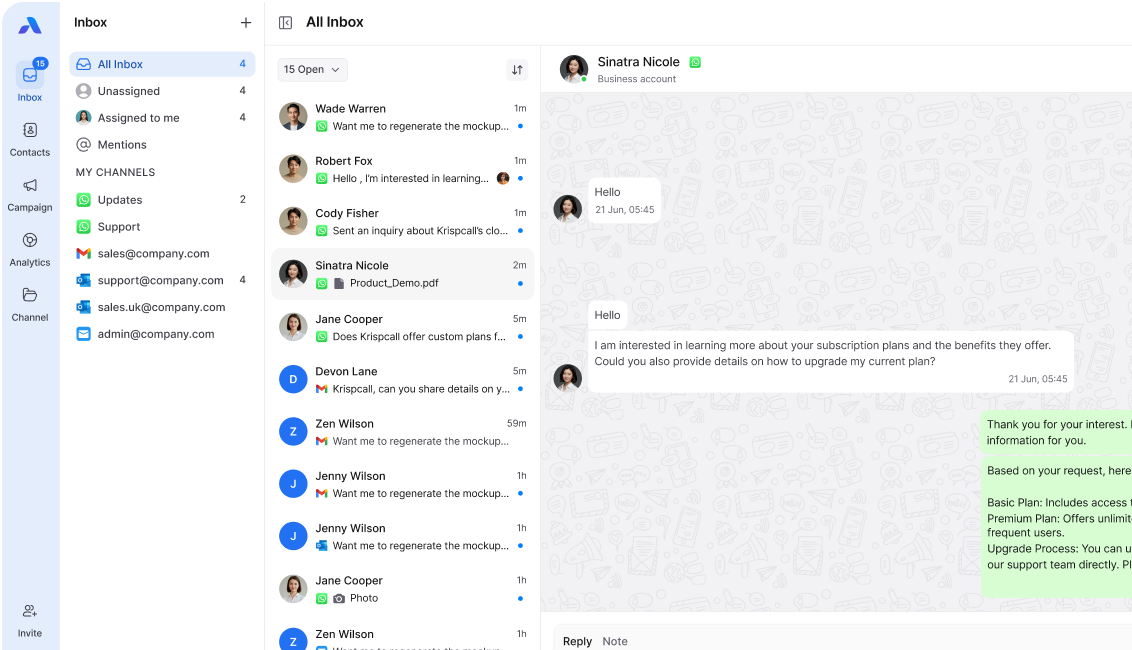
This is usually the point where businesses start exploring a shared inbox. A shared inbox brings team members into the same conversation thread, with visibility into who replied, who owns each chat, and what’s still open. It’s worth understanding as an option, even if you’re not ready to switch yet.
7-Day WhatsApp Lead Audit
Try this simple audit over one week to spot where leads are slipping through.
Day 1: Count how many WhatsApp messages you received and how many were answered same-day.
Day 2: Check your average response time for the day’s messages.
Day 3: Review your unread messages from the past week. Are any customers still waiting?
Day 4: Ask your team who owns each open conversation. Note any conversation with no clear owner.
Day 5: Look for any customer who asked a pricing or buying question and never got a follow-up.
Day 6: Check whether any two team members replied to the same customer without knowing it.
Day 7: Review the week. Write down your three biggest leaks and one fix for each.
Where Is Your Biggest Lead Leak?
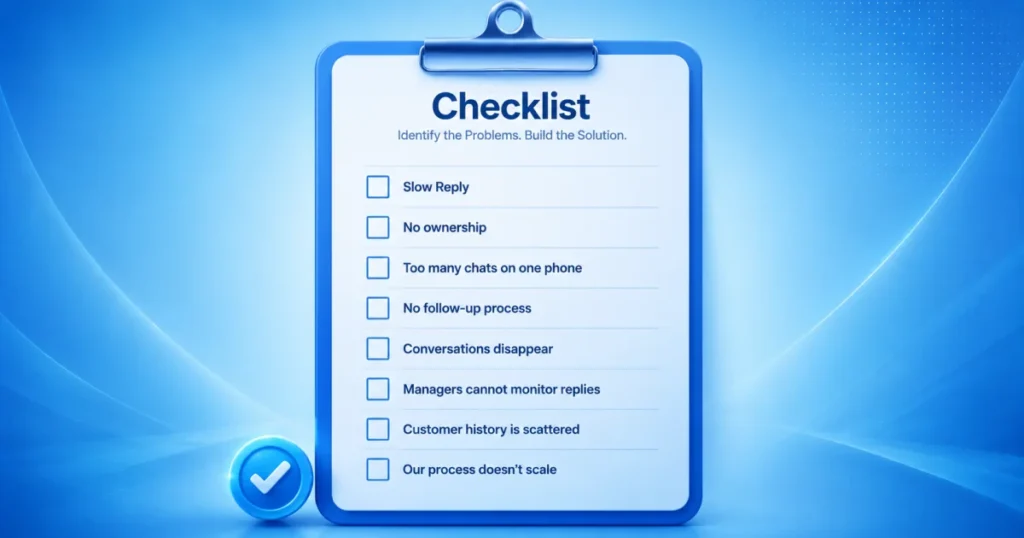
Check every box that’s true for your business right now.
☐ We reply too slowly
☐ Nobody owns conversations
☐ Too many chats on one phone
☐ No follow-up process
☐ Conversations disappear
☐ Managers cannot monitor replies
☐ Customer history is scattered
☐ Our process doesn’t scale
If you checked two or more boxes, your business likely has operational gaps that should be addressed before investing in additional lead generation.
Conclusion
Most businesses don’t need more leads. They already have enough customers reaching out on WhatsApp every day. What they need is a way to manage those conversations so fewer of them slip through the cracks.
Slow replies, unclear ownership, and missed follow-ups are process problems, not marketing problems. They’re usually the easiest ones to fix once you know where to look.
The next step is understanding how growing teams solve this at scale. Our next guide, How Shared Inboxes Reduce Missed WhatsApp Messages, walks through exactly how a shared inbox keeps every conversation visible, owned, and followed up on, even as your team grows.
FAQs
Why do businesses lose WhatsApp leads even when they reply eventually?
Speed matters as much as the reply itself. A high-intent customer who waits hours often buys elsewhere before your response arrives.
What is the biggest reason for missed WhatsApp messages?
Lack of clear ownership is one of the most common causes. When no one is specifically responsible for a conversation, everyone assumes someone else will handle it.
Can one person manage WhatsApp leads for a growing business?
It works at low volume, but manual, single-person management usually breaks down as message volume and team size increase.
How fast should a business reply to a WhatsApp lead?
There’s no universal number, but many businesses aim for under 15 minutes during business hours for high-intent messages, since WhatsApp users expect fast, conversational replies.
Do businesses need software to fix lost WhatsApp leads? Not always right away.
Not always right away. Fixing people and process issues first often solves a large part of the problem before any tool is needed.
What is a WhatsApp shared inbox?
A shared inbox lets multiple team members access and manage the same WhatsApp conversations together, with visibility into ownership and reply history.