Quick Answer: Why do customers feel ignored? Customers feel ignored because they cannot see the work happening behind the scenes. Your team might be checking stock or waiting on a manager, but the customer only sees silence. That silence reads as “we don’t care,” even when your team is working hard. This gap between internal effort and external visibility is called the Perception Gap.
Key Takeaways: The Perception Gap
- Speed is not everything. A fast reply that gets ignored still hurts trust. Visibility matters just as much as speed.
- Silence has a meaning. To a busy team, silence means “we’re working on it.” To a customer, silence means “we’re ignoring you.”
- Small gaps cause big churn. Customers rarely complain before they leave. They just stop replying and go to a competitor.
The Silent Churn
It’s 9 PM. A small business owner is still at their desk, digging through old records to solve a customer’s billing problem. They are trying hard.
Meanwhile, the customer stares at their phone. Their last message sits there, unanswered. They type: “Are you ever going to reply?”
The owner is not ignoring them. They are working. But the customer cannot see that work, so it does not exist to them.
This is the core problem in customer service today. Response speed is only half the battle. The other half is response visibility. And most businesses lose customers not because they were slow, but because they were invisible.
Silence does not sound like “working” to a customer. It sounds like ghosting.
What Is the Customer Perception Gap?
The Perception Gap is the space between what your team is actually doing and what your customer believes is happening. Your team sees effort. Your customer sees a blank screen.
Activity vs. Visibility
Your support team might spend 20 minutes checking a shipping database or waiting for a manager’s approval. That is real work. But if the customer does not get an update during those 20 minutes, none of that effort counts in their eyes.
Customers judge your service by what they can see, not by what you are actually doing. This is the heart of the Perception Gap.
The Perception vs. Reality Matrix
| What Your Team Is Doing | What Your Customer Sees | The Result |
| Checking stock levels | Silence | Customer feels unimportant |
| Waiting for manager approval | A “Read” receipt with no reply | Customer assumes they are being ignored |
| Researching a technical issue | No new messages for an hour | Customer starts looking at competitors |
| Passing the ticket to a specialist | The chat goes quiet mid-conversation | Customer thinks the issue was dropped |
| Drafting a careful, accurate answer | A long delay after “typing…” stops | Customer feels forgotten |
5 Reasons Your Customers Feel Ignored (Even When You’re Busy)
1. The WhatsApp Trap
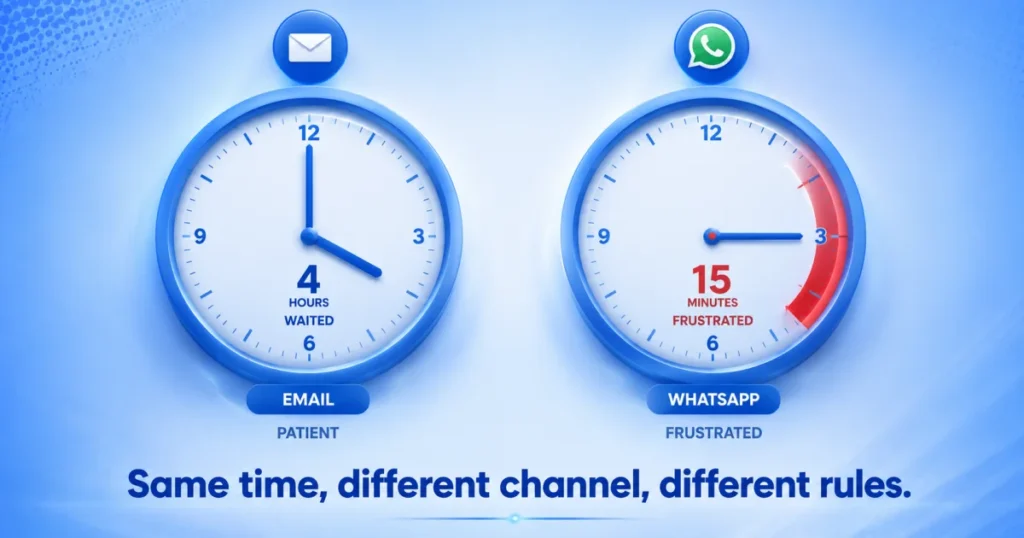
WhatsApp shows read receipts. Once that blue tick appears, the customer knows you saw their message. Now the clock is ticking in their head.
Ten minutes of silence on WhatsApp feels much longer than 24 hours of silence on email. Email has no read receipt, so customers do not expect an instant reply. WhatsApp removes that buffer, so every quiet minute feels personal.
2. The Internal Progress Black Hole
Teams often go quiet while they search for an answer. This makes sense internally. You do not want to send half-finished information.
But to the customer, this quiet period is a black hole. They have no idea if you are working on it, if you forgot, or if you moved on to someone else. A short “still checking on this” message would close that gap in seconds.
3. The Groundhog Day Effect
Picture a customer who messages on WhatsApp, then gets no answer, so they try email. Then they call. Each time, they repeat their order number and their problem from scratch.
This is thread fragmentation. It happens when conversations live in separate tools that don’t talk to each other. For the customer, it feels like living the same bad day over and over.
4. The No-Man’s-Land Hand-off
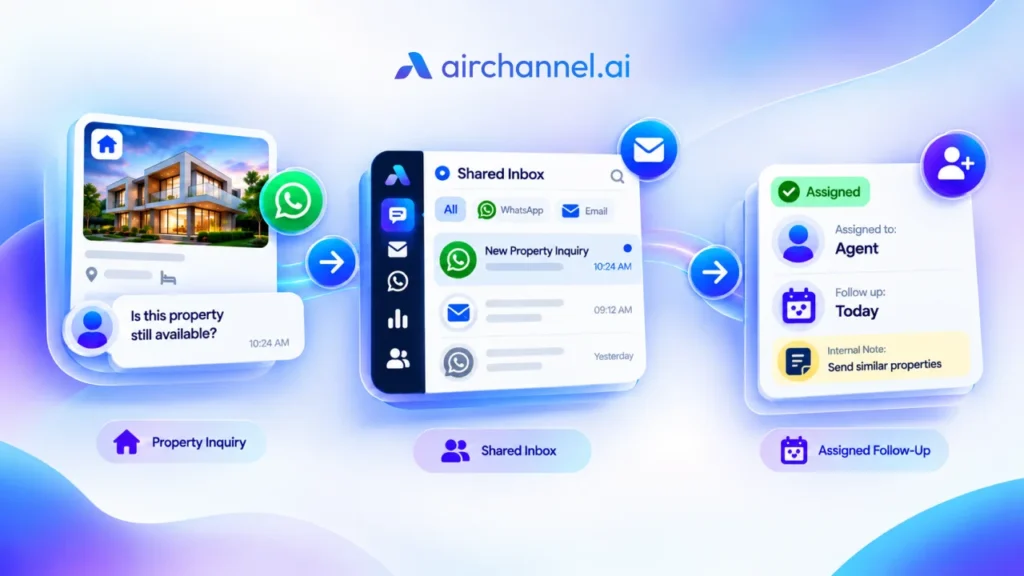
A support agent assigns a message to a specialist. Internally, this is progress. The right person is now looking at it.
But if nobody tells the customer “We’ve moved this to our specialist, and we’ll have an answer soon,” the customer just sees silence. The hand-off, which should feel like progress, feels like abandonment instead.
5. Inconsistent Tone
One agent replies warmly. Another replies short and formal. A third uses different words for the same policy.
To your team, these are just different people. To the customer, it looks like nobody is coordinating and nobody truly owns their problem. Inconsistent tone quietly damages brand trust.
Decoding Your Digital Body Language
In 2026, small signals like read receipts and typing bubbles carry real meaning. Customers read them the same way people read body language in a face-to-face conversation. Ignoring these signals is a mistake.
| Signal | What It Technically Means | What the Customer Feels |
| Read receipt, no reply | The message was opened | They saw it and don’t care |
| Last seen a while ago | The team member is away | Nobody is even watching this |
| Typing bubble, then it stops | The agent paused to check something | They started, then gave up on me |
| No receipts at all (email) | Normal for the channel | Less pressure, more patience |
The lesson is simple. On channels with visible signals, silence is loud. Your response strategy needs to account for that.
The Psychology of the Wait: Why Medium Matters
Not all channels carry the same expectations. A customer’s patience depends heavily on where the conversation is happening.
Response Expectation Table
| Channel | Typical Expected Response Time |
| WhatsApp / Live Chat | Under 10 minutes |
| Social Media DMs | Under 60 minutes |
| Under 24 hours |
This is perceived wait time at work. The same 30-minute delay feels reasonable on email but feels like abandonment on WhatsApp.
Omnichannel Friction
Omnichannel friction happens when a customer has to switch channels to get help. They start on chat, get no answer, and move to email. Now they must explain everything again.
Each switch resets their patience to zero. It also signals that your systems don’t talk to each other, which quietly damages trust before the conversation even continues.
The Real Cost of Being Invisible
The Perception Gap is not just an annoyance. It has a real business cost.
- Churn. Most unhappy customers do not complain. They simply stop replying and take their business elsewhere.
- Brand Trust. Trust takes years to build and only minutes to lose. One ignored message can undo months of good service.
- The Negative Review Spiral. A customer who feels ghosted is far more likely to leave a public review about it, which shapes how future customers see you before they even reach out.
A Real Example of Invisible Churn
A loyal client paying $500 a month has a small billing question. They message on WhatsApp, get a “Read” receipt, and then hear nothing for four hours. They don’t get angry. They just Google a competitor and quietly leave. By the time your team replies, they’ve already signed a new contract elsewhere.
How to Stop Accidental Ghosting: The Active Acknowledgment Strategy
You do not need to solve every problem instantly. You need to make sure the customer always knows where things stand. That is the goal of Active Acknowledgment.
The 3-Step Framework
- Acknowledge immediately. Even a short “Got it, looking into this now” closes the visibility gap right away.
- Set a timeline. Tell the customer when to expect an update, even a rough one like “within the hour.”
- Update even if there is no news. A message like “Still checking, thanks for your patience” keeps the customer informed and reduces perceived wait time.
This approach directly reduces response latency in the customer’s mind, even if the actual resolution takes the same amount of time.
The Ghosting Risk Scorecard
Answer Yes or No to see how exposed your team is to the Perception Gap.
- Do you use WhatsApp without a shared inbox?
- Do customers have to repeat their order number more than once?
- Do agents go quiet for more than 15 minutes without an update?
- Do different team members use different tones or wording?
- Do hand-offs happen without telling the customer?
If you answered “Yes” to two or more, your business likely has a real Perception Gap problem. The good news is that all five issues come from the same root cause: message silos, or conversations trapped in separate tools with no shared visibility.
From Missing Messages to Managing Conversations
The real shift is a mindset change. Support teams need to stop thinking in terms of “tickets” and start thinking in terms of relationships.
A ticket gets closed. A relationship gets maintained. Customers do not care about your internal ticket status. They care about feeling heard.
This is also where conversation ownership becomes important. When one person or one system clearly owns a conversation from start to finish, hand-offs stop feeling like No-Man’s-Land, and customers stop falling through the cracks.
FAQ
Does an auto-responder stop a customer from feeling ignored?
An auto-responder helps, but only a little. It confirms the message arrived, but it does not replace a real, human update. Without a follow-up, customers still feel forgotten once the auto-reply’s promise goes unmet.
Why is WhatsApp harder to manage than email?
WhatsApp shows read receipts and expects fast replies, often under 10 minutes. Email has no such visible signals, so customers naturally expect a slower response. This makes WhatsApp far less forgiving of silence.
How often should I update a customer on a long ticket?
As a general rule, update the customer at least once every few hours on active issues, even if there is no real progress to share. The update itself, not the progress, is what maintains trust.
What is the best way to handle a Read receipt?
Reply as soon as possible after reading a message, even with a short acknowledgment. If you must step away, send a quick note explaining the delay before the read receipt sits unanswered for too long.
Related Reading

Why customer messages get lost

Stop missing customer inquiries

Shared WhatsApp inbox

Customer communication platform
Closing the Perception Gap
Every business has a Perception Gap somewhere. The question is how wide yours has grown, and how much it is quietly costing you in trust and repeat business.
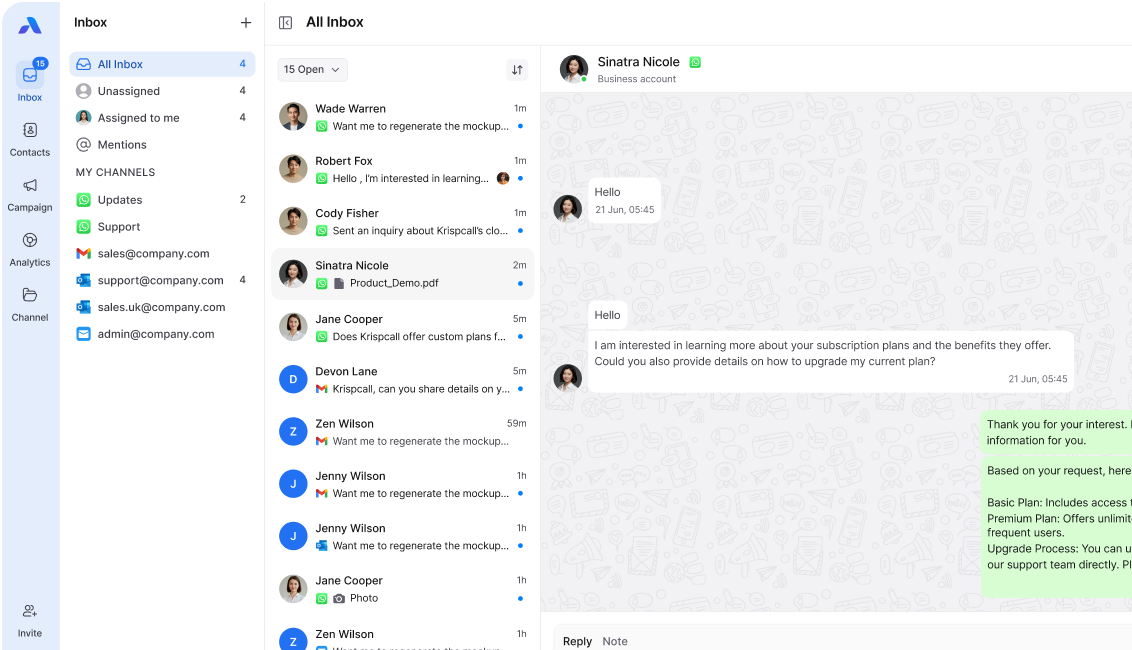
AirChannel.ai was built to close this exact gap. By bringing WhatsApp, email, SMS, and social messages into one shared inbox, your team can acknowledge, update, and follow through on every conversation without the customer ever feeling like they are shouting into a void.
If message silos and inconsistent hand-offs sound familiar, it might be time to see how a unified inbox from AirChannel.ai can help your team turn silence into steady, visible progress.