Quick Answer: Response time affects sales because buying impulse fades fast. Leads contacted within 5 minutes are dramatically more likely to convert than leads contacted after 30 minutes, with some studies from MIT and InsideSales.com showing qualification odds drop by more than 20 times. Every minute you wait, a prospect moves closer to a competitor, a distraction, or a decision to walk away. Speed is not a nice-to-have. It is a revenue lever.
Key Takeaways
- Speed builds trust. A fast reply signals competence before you say a single word about your product.
- The buying impulse is short-lived. Research from MIT and Harvard Business Review (HBR) shows lead quality drops sharply after the first few minutes.
- Slow replies fund your competitors. If a lead does not hear back, they search again. Your ad spend becomes someone else’s sale.
- Different channels have different patience levels. WhatsApp users expect a reply in under two minutes. Email buys you hours.
- Speed without context fails too. A fast, generic reply loses to a slightly slower, well-informed one. The two need to work together.
The Psychology of the Buying Impulse
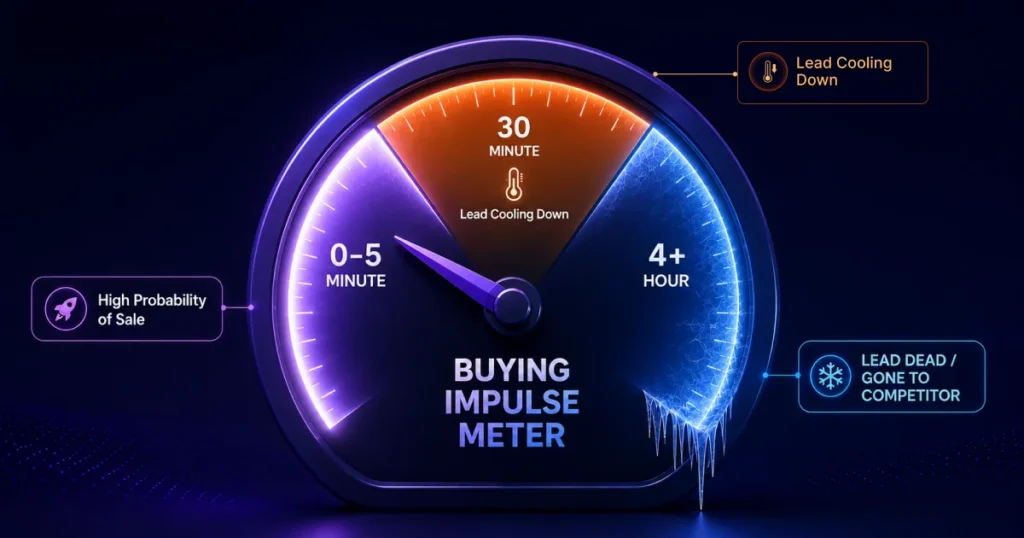
A buying impulse is a short window of high intent. A prospect fills out a form or sends a message at the exact moment their problem feels urgent. That urgency does not last.
The InsideSales.com and MIT Lead Response Management Study, led by researcher James Oldroyd, found that contacting a lead within 5 minutes made a business up to 21 times more likely to qualify that lead compared to waiting 30 minutes. A related audit published through Harvard Business Review found the average company took over 40 hours to respond to a new lead, and less than half replied within the first hour.
That gap between what buyers expect and what businesses deliver is where revenue disappears. The lead response rate, meaning the percentage of leads a business contacts before the window closes, is one of the strongest predictors of whether a lead ever turns into a sale.
The Second-Search Penalty: Paying for Your Competitor’s Leads
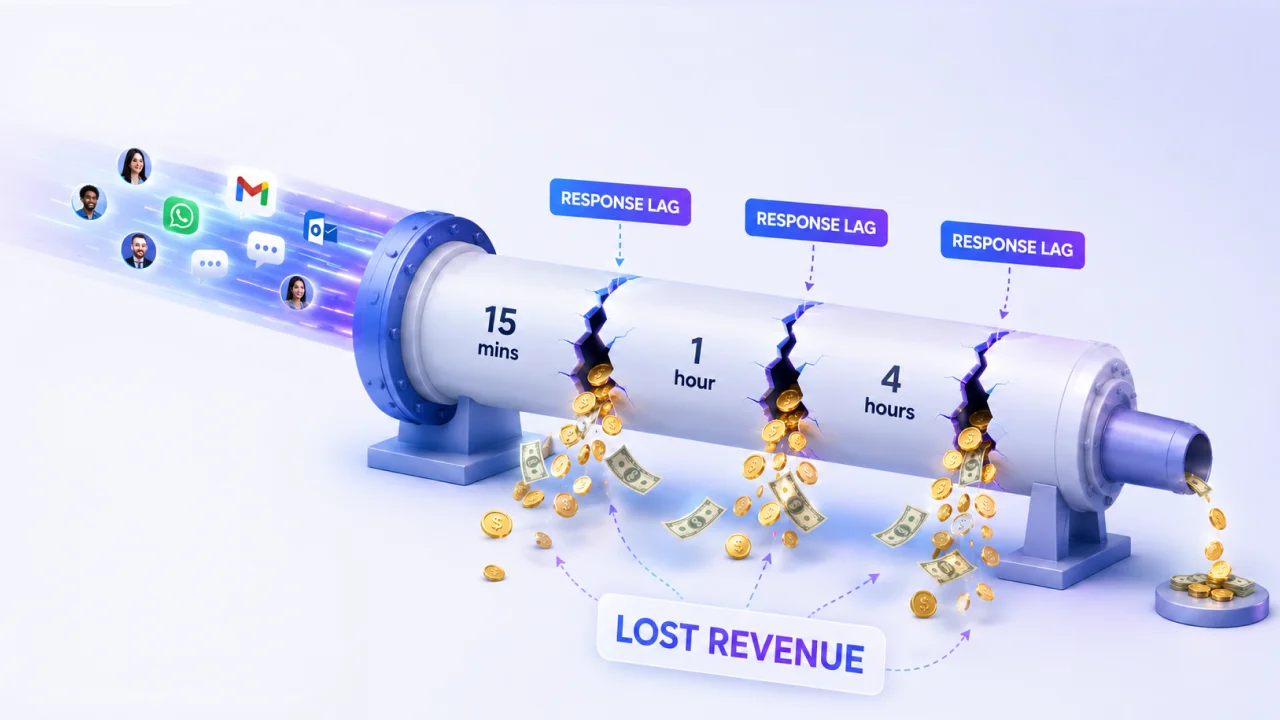
Here is what actually happens when you’re slow. A prospect searches for a solution, clicks your ad or your organic listing, and fills out your form. Then they wait.
If nothing happens in a reasonable window, they don’t sit still. They go back to the search results page and click the next name on the list. This is the Second-Search Penalty.
You already paid for that lead, whether through ad spend, content marketing, or months of SEO work. Your slow reply just handed the sale to whoever answered first. This is not a hypothetical. It is the default outcome of a broken revenue formula, where marketing generates demand, and sales fails to capture it in time.
User Patience Benchmarks: The Platform Grace Period Table
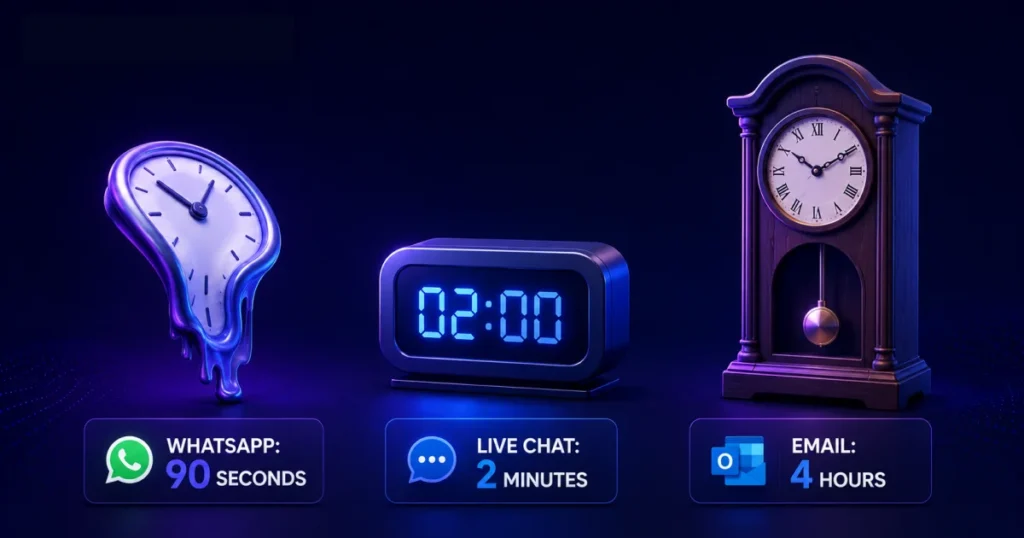
Not every channel gives you the same amount of time. Buyers set their patience based on the platform they used to reach you.
| Platform | Grace Period | Why |
| ~90 seconds | Users expect chat-speed replies, same as messaging a friend | |
| Live Chat | ~2 minutes | The prospect is actively on your site, waiting |
| ~4 hours | Async by nature, but still time-sensitive for sales inquiries |
Miss these windows and the lead’s attention moves elsewhere, even if they don’t consciously decide to abandon you. A WhatsApp message left on read for 20 minutes feels like a rejection. The same delay on email barely registers.
The Speed-to-Context Model
Speed gets you the conversation. Context is what closes it. A fast reply that says nothing useful is just a faster way to lose the deal.
Use this three-step checklist for every first reply:
- Acknowledge the specific request. Reference what they actually asked, not a generic greeting.
- Answer or advance in the same message. Give a real answer, a next step, or a clear path forward. Do not just say you’ll get back to them.
- Make the next action obvious. A calendar link, a direct question, or a clear choice. Remove friction for the buyer.
Speed is the opener. Context is the closer. You need both, and you need them together in the first message.
Why Your Team is Actually Slow (The Context-Switching Tax)
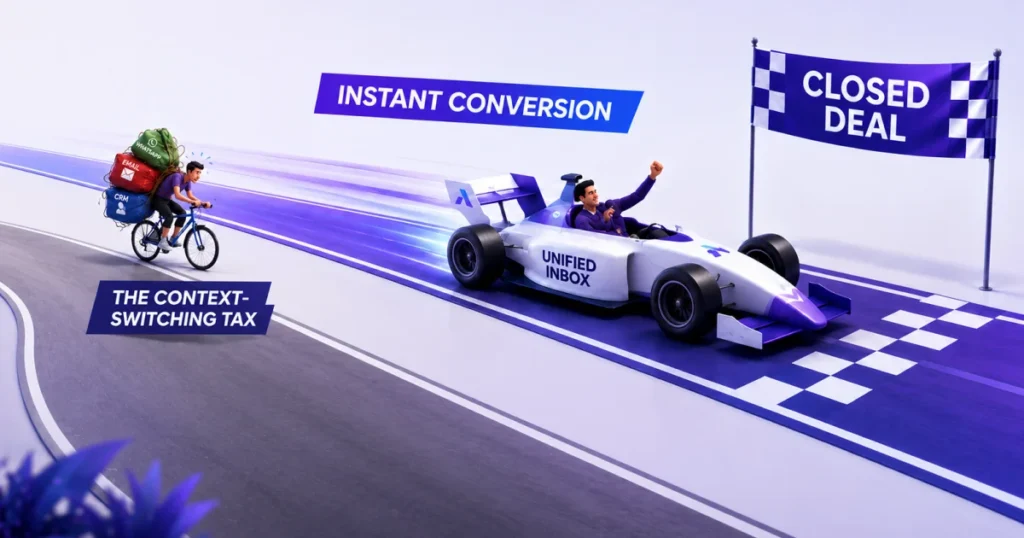
Slow response times are rarely about effort. They’re about attention.
Every time a support or sales rep switches from email to WhatsApp to a CRM tab to Slack, they pay a hidden cost. Psychologists call this attention residue: part of the brain stays stuck on the previous task even after switching to a new one. The rep who just left a call is still mentally processing it while trying to answer a WhatsApp message.
This context-switching tax adds up fast across a busy day. A team juggling five tools isn’t slow because they’re careless. They’re slow because their tools are working against them.
If your team consistently misses response-time targets, the root cause is usually structural, not personal. For a deeper breakdown of where these delays come from, see Why is my team replying slowly?
How AirChannel Solves the Human Variable
People are the hardest part of any response-time problem to fix directly. Tools are easier to fix, and the right tool removes a lot of the pressure on people.
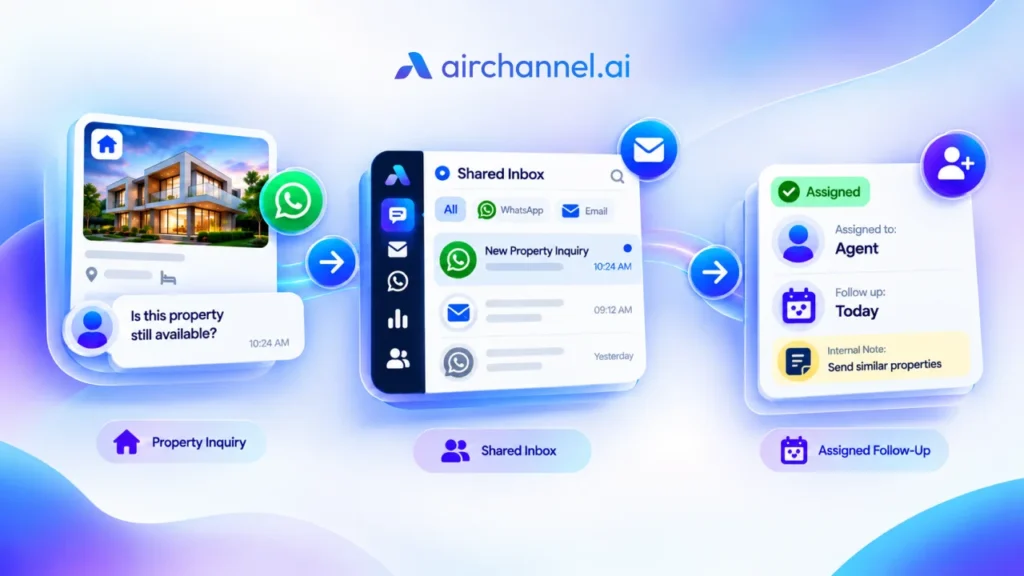
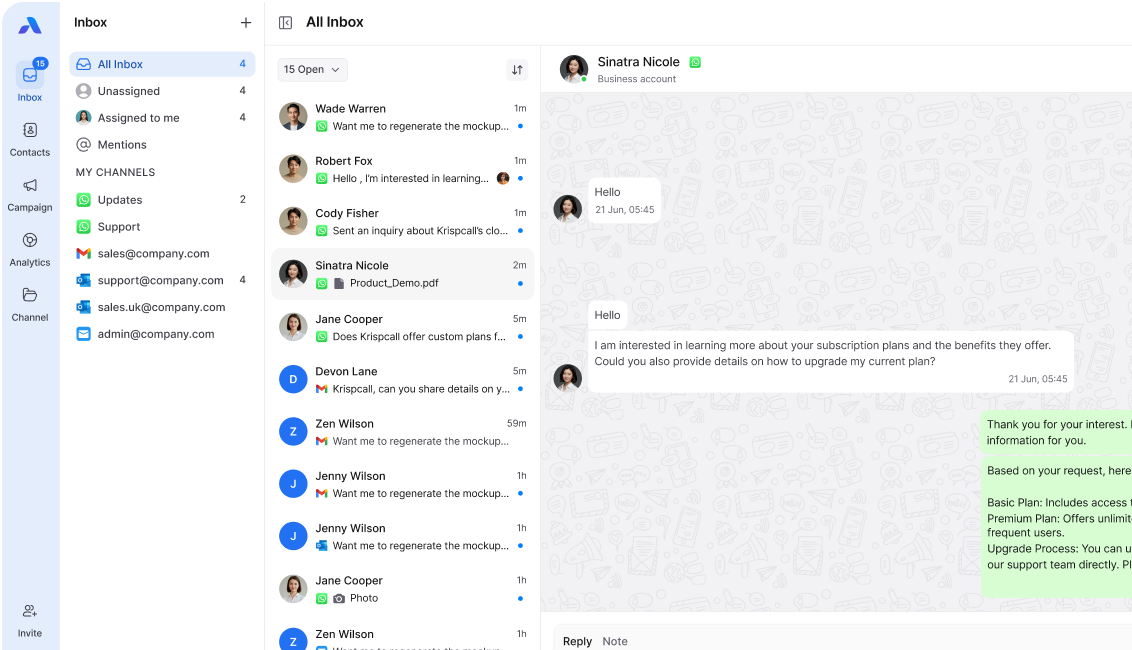
A unified inbox brings WhatsApp, email, and other channels into one screen. Instead of a rep tab-hopping between four apps to find one conversation, everything lives in a single place with full context attached.
This matters for two reasons. First, it cuts the context-switching tax, since reps aren’t reloading their mental state every time a message comes in on a different app. Second, it makes AI agent configuration possible: an AI agent can pick up simple, repetitive replies instantly, while human intervention kicks in for anything that needs judgment or a personal touch. The result is a system where speed and quality aren’t a trade-off anymore.
FAQ
Does an automated, “We received your message” count as a response?
No. A prospect wants a path to a solution, not proof that a message landed in an inbox. An auto-reply without a next step just delays the real response and can make the wait feel longer.
What is the Golden Window for B2B sales leads?
Most research points to the first 5 minutes as the highest-value window, with qualification odds dropping sharply after that. The first hour is still workable, but every minute past 5 costs you conversion probability.
How do we handle lead response times on weekends or after hours?
This is where AI agents matter most. A configured AI agent, like AirChannel’s Aurora Inbox assistant, can answer common questions and confirm receipt instantly, then hand off to a human the moment the conversation needs a real decision.
Is speed more important than the quality of the answer?
Neither wins alone. Speed gets attention before it fades. Context, meaning a genuinely useful answer, is what turns that attention into a sale. The Speed-to-Context model treats them as one system, not two competing priorities.
Ready to see where your team is losing leads?
Audit your current response time and find out how many minutes you’re giving away.
Curious what a unified inbox looks like in practice? See a demo of AirChannel.
Or skip straight to it: Start your free trial and stop losing leads to slow replies.